


Cybersecurity
Industrial Cybersecurity Companies

Industrial Cyber Security: More than just one company
The technological landscape is changing extensively with the advent of integrated systems with accessibility driving this development. Manufacturing and plant operation machines that used to have an air-gap between themselves and other systems are now dwindling with the push for integration. This is not necessarily a bad thing as it aids productivity and profitability. Linking systems is not just reserved for the company itself but also its supply chain pulling in materials and components as they are need. In fact, in the recent Covid-19 pandemic the need to switch suppliers quickly has allowed supermarkets and other essential industries to remain open.
Unfortunately, this advancement has increased challenges when it comes to cybersecurity. Hackers in recent years have attacked power stations, factories, hospitals and infrastructure. Some for profit and others working within governments to disrupt another competing countries GDP.
Some attack vectors have involved the exploitation of software supplied by 3rd contractors. For example, a large platform such as a product management lifecycle (PLM) software that is utilised extensively in manufacturing sectors to digitally replicate the design and manufacturing processes inevitably use existing software that it integrates in a modular basis. If any one of dependent software has malicious content it is unlikely that it will be detected at the time of installation and roll out.
Hackers recently used this process to gain access to a worldwide company all through gaining access through a smaller company and creating a backdoor that allowed them to then exploit the companies supply chain and sell industrial secretes to competitors. While this was not PLM software that was involved it was similar in scale and integration. Interestingly the hackers waited for years until the 3rd party software was widespread in other companies from other installations. This was a huge scandal as it took a long time for the software that they added was flagged, and through a long investigation the extent of the issue realised.
Industrial cybersecurity companies
Industrial cybersecurity companies hire the best and brightest for their teams, they work every day on cybersecurity activities and upskilling on the latest threats. Sometimes you just need specialists that specialise in cyber security. The challenge is still keeping up with new approaches.
Currently operational technology (OT) also called industrial control systems (ICS) are being targeted by hackers due to the extensive information about this technology readily available on the internet. This can be in the form of maintenance documentation, a method used to hack wireless printers recently and gaining network access from there. User instructional documentation or installation procedures may be used in a similar light. Some hackers use online videos for similar information. While one source may cover one item of interest to hackers another may complete the puzzle of how to gain access to a system.
Shodan: no coding, login or hacking experience necessary
One of the best examples of finding an exploitable route is the website Shodan. This is well known in the hacking community and is one of the best sites to see poorly maintained cybersecurity. A lot of white hat hackers use the site to find servers that are accessible and then contact the company to tell them that they need to fix the issue. Some companies listen while others ignore this advice. The site allows anyone to access these servers without a login required and free for a handful of searches. You could search your industry and click a remote connection to gain access to a system that may not even be password protected. This site shows a ‘grey area’ in hacking because a server that does not have a password for an accessible port is potentially legal to gain access to. Shodan allows anyone to find and access these sites which include power stations and airports with no restriction and with no coding or hacking experience needed.
Why can this occur; simply put due to contractors providing a platform and documenting that a client must harden their server that it has been used. The client however may not know anything about computers and leave ports such as FTP and remote access ports open and not providing a system password as they may forget what it is or have other users that use it. These are not old challenges, check out if your company is on Shodan and use Industrial cybersecurity companies peace of mind.


Summary: AI agents-autonomous software entities that connect users, systems, and corporate data to perform complex tasks-are being deployed across enterprise environments faster than security teams can track them. Built increasingly by non-technical business users on platforms like Microsoft Copilot Studio and Salesforce Agentforce, these agents introduce a new class of security challenges. This article examines the agentic AI threat landscape, how the market is evolving, and why adaptive, purpose-built security platforms represent the only viable path forward.
The Age of the Agentic Enterprise
Something fundamental is changing in how enterprises operate. Across virtually every industry, organizations are deploying AI agents-software entities capable of reasoning, planning, and executing multi-step tasks autonomously-to automate everything from customer service interactions to complex financial analysis workflows.
These are not simple chatbots or rule-based automations. Modern AI agents can access databases, call external APIs, interpret unstructured documents, generate and send communications, and trigger downstream business processes-all without human intervention at each step. Platforms like Microsoft Copilot Studio, Salesforce Agentforce, and ServiceNow’s AI capabilities have put agent-building tools directly in the hands of business users.
The scale of adoption is striking. According to data cited by Nokod Security, enterprises are now seeing more than 50 new AI agents added to their environments every single day. Multiply that across a quarter or a year, and the numbers become staggering: thousands of autonomous agents operating inside enterprise networks, many with access to sensitive data, connected systems, and critical workflows-and most with no formal security review.
Why Agentic AI Creates Unique Security Challenges
AI agents are fundamentally different from traditional enterprise software -and those differences create security challenges that conventional tools are ill-equipped to handle.
Traditional application security operates on a relatively simple model: analyze static code for known vulnerability patterns, test at fixed points in the development lifecycle, and monitor production systems with predefined rules. This model breaks down almost immediately when applied to AI agents, for several reasons:
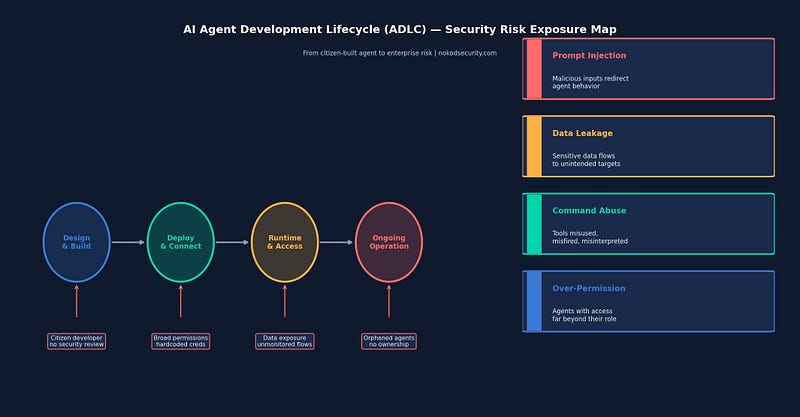
• Dynamic behavior: AI agents do not follow fixed execution paths. Their behavior depends on context, user inputs, model outputs, and real-time data-making static analysis largely ineffective.
• Citizen-built complexity: Most enterprise AI agents are built not by professional developers, but by business users who lack security training. The Agent Development Lifecycle (ADLC) is compressed, informal, and largely invisible to security teams.
• Broad data access: Agents are designed to be useful, which means they are given access to whatever data they need. Without careful governance, this quickly results in over-permissioned agents with access to data far beyond what their function requires.
• External connectivity: Agents routinely communicate with external APIs, webhooks, and cloud services. Each external connection is a potential exfiltration vector or injection point.
• Prompt injection vulnerabilities: Unlike traditional software, AI agents can be manipulated through their inputs-malicious instructions embedded in documents, emails, or user queries can redirect agent behavior in unpredictable ways.
• Orphaned agents: When the business user who built an agent moves on, the agent keeps running-often indefinitely-under permissions that were never designed to be permanent.
The Emerging Threat: Shadow AI
The phenomenon of shadow AI-AI agents and models deployed outside the formal purview of IT and security governance-is rapidly becoming one of the most significant enterprise security challenges of 2026. It combines the longstanding risks of shadow IT with the unique unpredictability of AI systems.
Security teams are generally aware of the problem in the abstract, but quantifying it is difficult. You cannot protect or govern what you cannot see, and the current state of most enterprise AI inventories is one of near-total opacity. Agents are built across multiple platforms, owned by different business units, and rarely documented in any systematic way.
For comprehensive research on AI governance best practices and frameworks, the National Institute of Standards and Technology (NIST) AI Risk Management Framework offers authoritative guidance for enterprises navigating this landscape.
How the Market Is Responding to Agentic AI Risk
The security industry is in the early stages of developing dedicated solutions for agentic AI risk. Several approaches have emerged:
AI Trust, Risk and Security Management (AI TRiSM) frameworks, as defined by Gartner, provide a conceptual model for governing AI across the enterprise. These frameworks address model explainability, data privacy, and operational resilience-but implementing them requires tooling that most organizations do not yet have.
Some SIEM and SOAR vendors are adding AI-specific detection rules and anomaly models. Cloud security posture management (CSPM) tools are being extended to cover AI services deployed in cloud environments. But these approaches are largely reactive and platform-specific, and they do not address the fundamental challenge of governing citizen-built agents across heterogeneous LCNC environments.
Nokod’s Approach: Adaptive Intelligence for a Dynamic Threat
Nokod Security has built its AI governance capabilities specifically around the realities of how enterprises actually deploy AI agents today-chaotically, rapidly, and across multiple platforms simultaneously.
At the foundation is comprehensive agent discovery and inventory. Nokod automatically maps every copilot, flow, and AI model across supported environments, including Microsoft Copilot Studio and Salesforce Agentforce. It tracks ownership, access permissions, data connections, and model dependencies-giving security teams the living map of their AI landscape that they currently lack.
Critically, Nokod goes beyond static discovery to offer what it calls Adaptive Agent Security: a real-time protection layer that learns the behavioral baseline of each individual agent, then continuously monitors for deviations. Rather than relying on static rules-which are impractical to define for the thousands of unique agents in a large enterprise-Nokod’s adaptive engine profiles each agent’s normal behavior and triggers alerts when something goes off-script.
The platform protects against the specific threats that AI agents face:
• Prompt injection and manipulation: Blocking malicious instructions before they can alter agent behavior.
• Data leakage: Real-time detection and prevention of sensitive data flowing to unauthorized destinations.
• Command abuse: Identifying when agent tools are being misused, misfired, or misinterpreted.
• Insecure calls and risky webhooks: Continuous scanning for unencrypted communications and unauthorized external triggers.
Governance as a Competitive Advantage
Organizations that invest in enterprise AI governance now are positioning themselves for a significant competitive advantage. The ability to deploy AI agents rapidly and confidently-knowing that security guardrails are in place-is a material differentiator in an environment where many enterprises are still paralyzed by uncertainty about AI risk.
Regulatory requirements are also accelerating. The EU AI Act, SEC cybersecurity disclosure rules, and industry-specific regulations like HIPAA and PCI-DSS all have implications for organizations deploying AI agents in production environments. Demonstrating control and governance over AI systems will increasingly be a compliance requirement, not just a best practice.
Conclusion
The agentic AI era is already here. Enterprises that wait for their existing security tools to catch up with the pace of AI agent deployment are accepting a risk they cannot afford. The combination of dynamic behavior, citizen development, broad data access, and prompt injection vulnerabilities creates a threat profile that demands a fundamentally different security approach.
Platforms that deliver true enterprise ai governance-with adaptive, real-time protection that learns and evolves alongside the agents it governs -represent the only sustainable answer to this challenge. Nokod Security is built by AppSec veterans who understand this problem from the inside out, and its platform reflects that depth of expertise.
Cybersecurity
Microsoft Power Platform Security: The Risks You Cannot See and How to Address Them
Learn about the hidden security risks in Microsoft Power Platform and how Nokod Security helps protect your enterprise with tools for visibility, vulnerability detection, and compliance.

Microsoft Power Platform has become the backbone of citizen development across enterprises worldwide. Power Apps, Power Automate, Power BI, and Copilot Studio collectively enable millions of business users to build applications, automate workflows, analyze data, and deploy AI agents – all without writing code. But the same capabilities that make Power Platform indispensable also make it one of the most significant unmanaged security risks in the modern enterprise. This article examines the security challenges specific to Microsoft Power Platform and explains how Nokod Security addresses them.
Why Microsoft Power Platform Creates a New Security Paradigm
Power Platform is not a single product. It is an integrated ecosystem of tools that share a common data platform (Dataverse), a common connector framework, and a common identity model (Microsoft Entra). When a citizen developer builds a Power App that calls a Power Automate flow that reads from SharePoint and writes to SQL Server, they are creating a multi-system data pathway that traditional AppSec tools are entirely blind to.
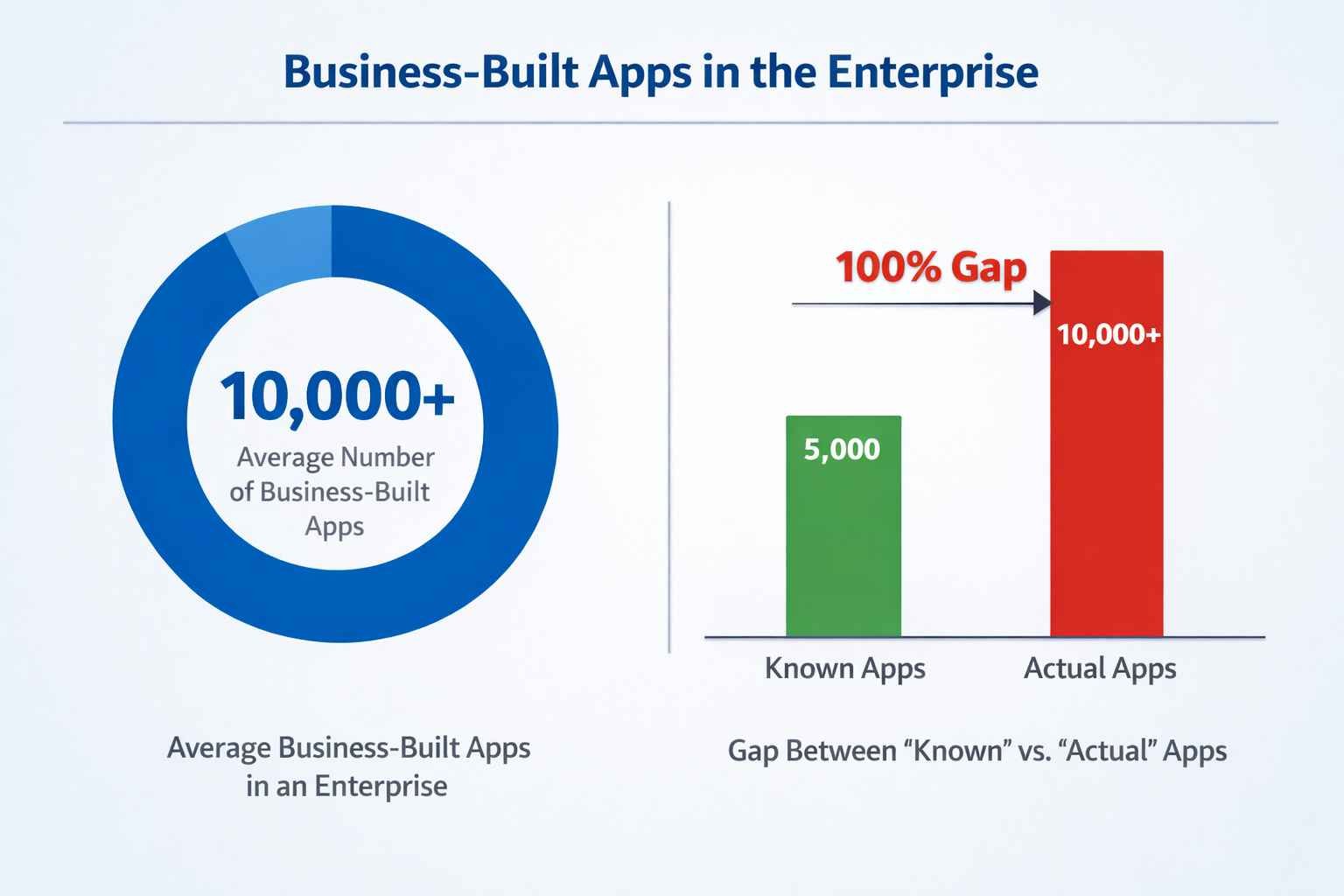
The challenge is amplified by scale. According to Nokod, the average enterprise contains more than 10,000 business-built apps. A significant proportion of these are Power Platform applications and flows. Twenty percent of no-code apps are exposed externally. The gap between what security teams think they have and what exists in reality is one hundred percent.
To get started with Power Platform security, visit Nokod Power Platform Security.
Power Platform Security Risks: What Security Teams Need to Understand
The security risks within Microsoft Power Platform span all three major components:
Power Apps
- Apps built with excess permissions that allow access to sensitive Dataverse tables beyond what users need
- Apps shared tenant-wide or externally, making internal data accessible to unauthorized users
- Orphaned apps retaining connections and permissions after their creator has left the organization
- Injection vulnerabilities embedded in app logic that processes user input
Power Automate
- Flows that run under service accounts with overprivileged access to critical systems
- Unencrypted HTTP actions sending sensitive data to external endpoints
- Malicious third-party connectors embedded in automation workflows
- Flows triggering unauthorized actions in downstream systems like ERPs and CRMs
Power BI
The Nokod Research Team discovered a significant data leakage vulnerability in the Microsoft Power BI service affecting potentially tens of thousands of organizations. The issue relates to the relationship between Power BI report objects and their underlying semantic models. When a Power BI report is shared with users, all raw data represented by the underlying semantic model is also accessible to those users – including detailed data records that are used only for aggregations in the report UI. This means anonymous viewers may be able to access sensitive data, including employee data, business data, PHI, and PII, even when the report is not intended to surface that information.
Nokod reported the finding to the Microsoft Security Response Center (MSRC) and created a free Power BI Analyzer tool to help organizations assess their exposure to this vulnerability.
For information on securing Copilot Studio within your Power Platform environment, see Nokod Copilot Studio Security.
How Nokod Secures Microsoft Power Platform
Nokod Security offers a free attack surface assessment tool for Microsoft Power Platform, allowing organizations to immediately understand the scope of their exposure before committing to a full deployment. The full Nokod platform integrates with the Power Platform environment within minutes, using the native API to deliver comprehensive visibility across all apps, flows, and connected services.
Key capabilities for Power Platform security include:
- Complete discovery of all Power Apps, Power Automate flows, and Power BI reports across the tenant
- Inventory of all connections and connectors, including third-party and custom connectors
- Vulnerability detection for injection attacks, insecure HTTP calls, risky webhooks, and malicious integrations
- Access and permission auditing, including identification of excess permissions and oversharing
- Governance policy management with automated remediation and developer-friendly guidance
- Compliance monitoring for regulatory requirements including PCI DSS, HIPAA, and SOC 2
Power Platform Security and the Broader Enterprise LCNC Landscape
Power Platform rarely exists in isolation within an enterprise. It connects to SharePoint, Teams, Dataverse, Azure services, Salesforce, ServiceNow, and dozens of third-party systems. Security governance that addresses only Power Platform leaves significant gaps.
Nokod’s approach is inherently multi-platform. By providing a single security and governance layer across all citizen-developed and AI-agent-built applications – regardless of the underlying platform Nokod enables security teams to see the full attack surface and apply consistent policies across every environment.
Nokod is ISO-certified and SOC 2 compliant, and its management team includes founders of Imperva and SecuredTouch (now Ping Identity), bringing decades of application security expertise to the LCNC and AI-agent security space.
To explore the full platform, visit nokodsecurity.com.
Frequently Asked Questions
Q: What is Microsoft Power Platform?
A: Microsoft Power Platform is an integrated suite of low-code tools including Power Apps, Power Automate, Power BI, and Copilot Studio. It enables business users to build applications, automate workflows, analyze data, and deploy AI agents without professional development skills.
Q: What Power BI vulnerability did Nokod discover?
A: The Nokod Research Team found that sharing a Power BI report also exposes all underlying raw data in the semantic model including data not shown in the report UI- to all users with access. This can include sensitive PII, PHI, and business data.
Q: Does Nokod offer a free assessment for Power Platform?
A: Yes. Nokod Security provides a free attack surface assessment tool for Microsoft Power Platform to help organizations quickly understand their exposure.
Q: How does Nokod integrate with Power Platform?
A: Nokod connects to Power Platform through its native API and can deliver visibility within minutes of connection, without requiring any agents or endpoint installations.
Q: What compliance standards does Nokod support for Power Platform?
A: Nokod helps organizations achieve compliance with PCI DSS, HIPAA, SOC 2, and other regulatory frameworks within their Power Platform environments. Nokod itself is ISO-certified and SOC 2 compliant.
Business Solutions
Automotive IDS (Intrusion Detection Software): Safeguarding the Future of Connected Vehicles

The evolution of connected vehicles, autonomous driving systems, and over-the-air (OTA) updates has transformed the automotive industry into a high-tech environment. While these advancements offer numerous benefits, they also introduce new cybersecurity vulnerabilities. As modern vehicles become more complex and interconnected, the need to protect them from cyber-attacks becomes ever more urgent. One of the critical solutions to address these threats is the integration of Automotive Intrusion Detection Software (IDS Automotive).
Automotive IDS is designed to monitor vehicle systems in real-time, detect malicious activities, and respond to potential cybersecurity threats. In an era where vehicles are increasingly targeted by cybercriminals, an effective IDS plays a pivotal role in safeguarding not just the vehicle’s software and hardware, but also the safety of drivers, passengers, and other road users.
What is Automotive Intrusion Detection Software (IDS)?
Intrusion Detection Software (IDS) is a security technology that monitors and analyzes the activities of a system to detect signs of unauthorized access or suspicious behavior. In the context of automotive cybersecurity, IDS focuses on identifying and preventing attacks on a vehicle’s electronic control units (ECUs), communication networks, and other critical systems.
An automotive IDS typically operates by detecting irregularities in vehicle behavior that could indicate a cyberattack, such as unusual data traffic, unauthorized commands, or abnormal sensor readings. It analyzes the vehicle’s internal network traffic, such as Controller Area Network (CAN) bus, Ethernet, and FlexRay protocols, for any signs of intrusion or tampering.
How Automotive IDS Works
Automotive IDS operates in much the same way as traditional intrusion detection systems used in IT security, with some key differences specific to the automotive context:
1. Data Monitoring:
Automotive IDS continuously monitors the internal communication networks of a vehicle, including the CAN bus, Ethernet, and other communication channels. These networks serve as the backbone for data transmission between the vehicle’s various ECUs (e.g., engine control, infotainment, braking, steering), sensors, and actuators.
2. Anomaly Detection:
IDS systems typically use anomaly-based detection techniques to identify abnormal behavior in vehicle communication patterns. By establishing a baseline for “normal” vehicle behavior, the IDS can flag any activity that deviates from this baseline. Examples of anomalies could include unexpected changes in sensor readings, unusual messages between ECUs, or abnormal network traffic patterns that may indicate a cyberattack.
3. Signature-Based Detection:
Some IDS systems also use signature-based detection, which compares vehicle behavior against known attack signatures or pre-defined patterns of malicious activity. These signatures are updated regularly to reflect emerging threats, ensuring that the IDS can detect even the most recent attack methods.
4. Response Mechanisms:
Upon detecting a potential intrusion or anomaly, the IDS can trigger predefined responses to mitigate the threat. This may involve logging the event for further investigation, sending alerts to the vehicle’s central control unit, or taking immediate action such as isolating affected ECUs or triggering a failsafe mode to ensure safety.
5. Integration with Vehicle Security Systems:
An automotive IDS is typically integrated with other vehicle security systems, such as firewalls, secure communication protocols, and encryption mechanisms. This multi-layered security approach enhances the vehicle’s ability to prevent, detect, and respond to cyber threats.
Why is Automotive IDS Important?
The importance of Automotive IDS cannot be overstated in today’s connected car ecosystem. The integration of increasingly sophisticated technologies, like Advanced Driver Assistance Systems (ADAS) and autonomous driving features, has expanded the attack surface for potential cybercriminals. Here are several reasons why Automotive IDS is crucial:
1. Protecting Critical Vehicle Functions:
Modern vehicles are highly dependent on complex electronic systems to manage safety-critical functions, such as braking, steering, and acceleration. A successful cyberattack on these systems could have catastrophic consequences. Automotive IDS helps prevent unauthorized access to these systems by detecting and responding to potential threats in real-time.
2. Early Detection of Cyber Threats:
Intrusion detection software is one of the best tools for identifying cyberattacks before they can do significant damage. Whether it’s a remote hacker attempting to gain control of a vehicle’s systems or a local attacker trying to exploit vulnerabilities, an IDS can alert the vehicle’s control systems to the presence of an attack, enabling timely countermeasures.
3. Mitigating Risks to Privacy:
Connected vehicles gather and share vast amounts of data, from GPS locations to personal preferences. Cybercriminals may target these data streams to compromise users’ privacy. Automotive IDS helps prevent data breaches by identifying suspicious activity on the vehicle’s communication channels.
4. Real-Time Monitoring and Response:
In contrast to traditional vehicle security solutions, which may only provide post-event analysis, IDS operates in real-time. This means that a vehicle’s security systems can immediately detect and respond to an ongoing attack, minimizing the potential damage and ensuring that the vehicle remains operational and safe.
5. Compliance with Regulatory Standards:
The automotive industry is subject to increasing regulatory scrutiny related to cybersecurity, including standards like ISO/SAE 21434 for automotive cybersecurity and the UN R155 regulation for vehicle cyber resilience. Implementing Automotive IDS can help manufacturers meet these regulatory requirements and demonstrate their commitment to vehicle safety and security.
Types of Automotive IDS
There are two main types of IDS that can be used in automotive cybersecurity:
1. Host-Based IDS (HIDS):
Host-based IDS operates on individual ECUs or control units within the vehicle. These systems monitor the specific behaviors of the vehicle’s hardware and software to detect intrusions. HIDS can track file integrity, system configurations, and application behavior, providing detailed insights into any changes that could indicate an attack.
2. Network-Based IDS (NIDS):
Network-based IDS monitors the vehicle’s communication networks, such as CAN and Ethernet, to detect unauthorized or suspicious network traffic. NIDS analyzes the flow of messages between ECUs, sensors, and other vehicle components, looking for signs of malicious activity or abnormal data exchanges.
In many cases, an automotive cybersecurity system will use a combination of both HIDS and NIDS to provide comprehensive coverage against cyber threats.
Challenges in Implementing Automotive IDS
While the benefits of automotive IDS are clear, the implementation of these systems comes with its own set of challenges:
1. Complex Vehicle Architectures:
Modern vehicles contain a vast array of ECUs, sensors, and communication networks, each with unique security needs. Designing an IDS system that can effectively monitor and protect all these components is complex and requires integration with the vehicle’s entire electronic ecosystem.
2. Real-Time Processing:
Given the critical nature of vehicle operations, IDS systems must be able to detect threats in real-time without causing delays or performance degradation. This requires high processing power and advanced algorithms capable of handling large amounts of data quickly and efficiently.
3. False Positives:
One of the challenges with any IDS system is minimizing false positives — situations where benign activity is mistakenly flagged as malicious. In automotive contexts, false positives can be particularly problematic, as they may cause unnecessary disruptions to vehicle operations or trigger incorrect safety measures.
4. Evolving Cyber Threats:
The cybersecurity landscape is constantly evolving, with new attack methods and vulnerabilities emerging regularly. Automotive IDS systems need to be updated continuously to stay ahead of these threats. This can require ongoing development and support to ensure that vehicles remain secure over time.
As the automotive industry embraces the future of connectivity and automation, the need for robust cybersecurity measures has never been more critical. Automotive Intrusion Detection Software (IDS) serves as a vital component in safeguarding vehicles from the growing threat of cyber-attacks. By detecting and mitigating potential intrusions in real-time, IDS helps protect not only vehicle safety and privacy but also the reputation of manufacturers in an increasingly security-conscious market. As automotive technology continues to advance, the role of IDS in ensuring the integrity of connected and autonomous vehicles will only become more important.

Edge AI Explained: How On-Device AI Processing Is Replacing the Cloud
The Rise of System-in-Package (SiP): How Advanced IC Packaging Is Redefining Electronics Miniaturization
Wire Bonding vs. Flip Chip: Navigating the Evolving World of IC Interconnect Technology

-
Business Solutions2 years ago
Understanding A2P Messaging and the Bulk SMS Business Landscape
-

 Business Solutions2 years ago
The Power of Smarts SMS and Single Platform Chat Messaging
-

 Business Solutions2 years ago
Exploring OTP Smart Features in Smart Messaging Services
-

 Business Solutions2 years ago
Live Video Broadcasting with Bonded Transmission Technology
-

 Business Solutions1 year ago
The Future of Healthcare SMS and RCS Messaging
-

 Business Solutions2 years ago
2-Way Texting Solutions from Company Message Services
-

 Business Solutions2 years ago
Communication with Analog to Fiber Converters & RF Link Budgets
-

 Business Solutions2 years ago
B2B vs. B2C Content Creation: Tailoring Your Message to Win the Deal