


Software
Human and Organizational Performance Software

Using human and organizational performance software, you can manage, visualize, communicate, and interact across all levels of the company, for example through dashboards, strategy maps, and initiatives. With the holistic and individual levels of objectives and performance clearly quantified, visualized, and communicated, you can easily accomplish board-level reporting, drive actions towards future growth, as well as assure strategic alignment of operations across the business.
The performance software enables businesses to manage responsiveness and recovery, convey the context for change, and share the definitions of success. The human and organizational performance software gives insight to performance throughout the whole company and allows decision-makers to understand issues and make business choices within the business context. Additionally, one may examine procedures for future growth and convey risk aspects.
Connected worker platform
Industrial organizations may use a connected worker platform to provide their employees with the tools they need to collaborate on production processes and supply chain activities.
Who Is a Connected Worker?
Frontline employees have distinct needs from office workers in terms of time and task management. Connected employees may use digital technologies and data management strategies to better connect with their physical and virtual environments. They can make judgments quicker, better, and safer, enabling and optimizing a process or group of procedures.
Industry 5.0 & Connected Worker Platform
Throughout the waves of industrialization, steam engines have replaced horses and men. The engines were replaced by electricity at some point. These were adopted throughout the course of centuries.
Finally, software took over and automated operations in the last decade. To link goods and consumers with Industry 5.0 in the past decade, sensors have been used to allow telemetry. However, in most businesses, operations are monotonous linear sequences of activities that are sluggish, imprecise, and inefficient. Front-line employees have been on the sidelines for the last 20 years, waiting and observing.
Human and Organization Performance
Many firms have recently discussed and expressed interest in human and organization performance, which they regard as a superior way to improve safety performance. It is based on the premise that human error is unavoidable, and that through improving process system management and analysis, companies can limit the impact of a human mistake by promoting risk-reducing measures.
Organizations may improve the robustness of their management systems by first learning how people conduct their everyday job duties, then identifying holes or faults in the management system, and sealing the gaps using what are known as defenses.
Organizational performance is about experience and communication, and it aims to comprehend the information received and ideas offered by people closest to the job – the front-line employees who identify error-prone circumstances because they have been in them.
The other aspect of human and organization performance that most people are aware of is employing a systems safety approach to discover, explain, and eliminate or control faults. Engineering and management techniques are used to discover, assess, and control risks, not simply hazards, in a systems-based approach to safety. Human variables, as well as any organizational characteristics that might compromise defenses and increase risk, are recognized and handled throughout this procedure.
Conclusion
The recognition and reward of outstanding achievement should be given at all times. It is possible for employees to get demotivated if they perceive that their efforts and performance have gone unseen and unrewarded, causing them to become disengaged from the organization’s ultimate goals.
Many large corporations consider reward and recognition programs to be a means of disbursing financial incentives such as bonuses and raises. However, the simple acknowledgment of hardworking staff may be an important part of keeping morale up.


Edge AI Explained: How On-Device AI Processing Is Replacing the Cloud
The phrase ‘AI in the cloud’ dominated the technology conversation for most of the past decade. But for a growing number of applications – autonomous vehicles, industrial inspection, smart cameras, medical devices – cloud latency and connectivity dependence are not acceptable constraints. The answer is edge AI: the practice of running AI inference directly on the device generating the data.
This shift is not incremental. It represents a fundamental rethinking of where intelligence lives in a computing system. Understanding the architecture, tradeoffs, and hardware that enables edge AI is essential for any engineer or product team building AI-powered systems today.
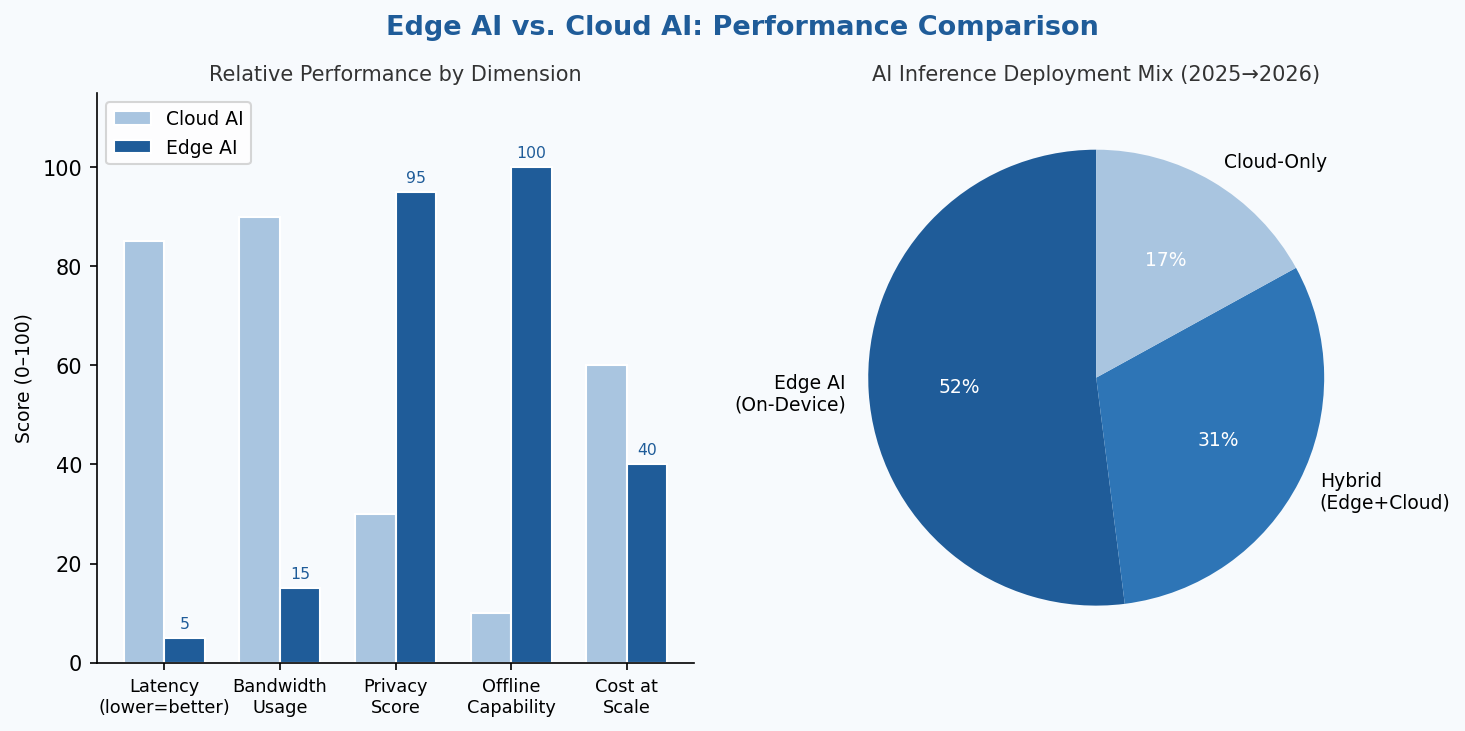
Figure 1: Edge AI vs. Cloud AI – relative performance across latency, privacy, cost, and offline capability, plus 2025–2026 deployment mix shift.
What Is Edge AI?
Edge AI refers to AI inference performed locally – on a device at or near the data source – rather than on a remote server or cloud platform. The ‘edge’ is defined by proximity to the data: a camera, a robot, a vehicle, a medical monitor.
The core operation in edge AI is inference: feeding data through a trained neural network to produce a prediction, classification, or detection result. Training these models still typically happens in the cloud using large GPU clusters. But once trained, the model can be compiled and optimized to run on purpose-built edge hardware.
Why ‘AI at the Edge’ Is Gaining Momentum
Three converging forces are driving the move from cloud to edge:
- Latency requirements: Applications like autonomous driving, industrial safety systems, and augmented reality require decisions in milliseconds. Round-trip latency to a cloud data center cannot reliably achieve this.
- Connectivity constraints: Many edge environments – factories, agricultural fields, underground infrastructure – have unreliable or absent internet connectivity. Cloud-dependent AI is not viable here.
- Data privacy and sovereignty: Regulations in healthcare, finance, and government increasingly restrict where data can be processed. On-device inference ensures that sensitive data never leaves the physical device.
The economics have also shifted. The cost of purpose-built edge AI silicon has dropped significantly, while cloud inference costs scale with usage. For high-frequency inference tasks – such as analyzing every frame from a hundred cameras – the break-even point strongly favors edge processing.
The Hardware That Makes Edge AI Possible
Not all processors are suited to AI inference. Running a modern object detection network on a general-purpose CPU is feasible but inefficient. Dedicated AI accelerators solve this through hardware architecture designed for the matrix multiplication and convolution operations that dominate neural network computation.
| Hardware Type | Architecture | Typical Use Case | TOPS Range |
| General CPU | Sequential / SIMD | Low-throughput inference | < 1 TOPS |
| GPU (embedded) | Parallel CUDA cores | Flexible, power-intensive | 1–10 TOPS |
| Dedicated AI Accelerator | Dataflow / systolic arrays | High-efficiency inference | 10–50+ TOPS |
| Vision Processing Unit | Fused vision + AI pipeline | Camera-integrated applications | 5–30 TOPS |
Purpose-built AI accelerators such as the Hailo-8 AI Accelerator deliver significantly higher TOPS-per-watt than GPU-based alternatives – a critical metric for battery-powered or thermally constrained edge deployments.
Edge AI vs. Cloud AI: A Practical Comparison
| Dimension | Cloud AI | Edge AI |
| Latency | 50ms–2000ms (network dependent) | < 10ms |
| Privacy | Data transmitted externally | Data stays on-device |
| Offline | Not available | Full functionality |
| Model complexity | Unlimited (server resources) | Constrained by hardware |
| Cost model | Pay-per-inference, scales up | Fixed hardware investment |
| Best for | Batch processing, complex models | Real-time, latency-critical |
Software: The Missing Piece in Edge AI Deployments
Hardware capability is only as useful as the software ecosystem surrounding it. Deploying a neural network to an edge device requires a compilation toolchain that translates the model – typically developed in PyTorch or TensorFlow – into an optimized binary for the target hardware.
The best edge AI platforms provide:
- A model compiler that handles quantization, layer fusion, and memory optimization automatically
- A runtime library for efficient inference execution
- Pre-compiled model libraries (model zoos) for common tasks
- Profiling tools to measure per-layer performance and identify bottlenecks
- Integration examples for popular platforms including Raspberry Pi, NVIDIA Jetson, and industrial SBCs
The Hailo AI Software Suite delivers this complete pipeline, making it possible to go from a PyTorch model to a running edge deployment with minimal platform-specific engineering. The Hailo Developer Zone provides documentation, tutorials, and pre-compiled models to accelerate time-to-deployment.
For a broader technical overview of edge AI architectures, IEEE Spectrum’s coverage of edge computing provides a solid reference point on where the industry is heading.
Real-World Edge AI Use Cases
The breadth of edge AI applications continues to expand. Current high-volume deployments include:
- Smart retail: People counting, queue detection, and product recognition running on in-store cameras without cloud dependency.
- Automotive ADAS: Driver assistance features – lane departure, pedestrian detection, sign recognition – all processed in-vehicle for safety-critical response times.
- Industrial quality control: Automated optical inspection on production lines, detecting defects at rates that exceed human inspection.
- Smart home and security: Object recognition, package detection, and intruder alerts running locally on home hubs or camera modules.
- Healthcare monitoring: Patient movement analysis and fall detection in care environments, with strict data privacy guarantees.
Conclusion
Edge AI is not a replacement for cloud computing – it is a complement that brings intelligence to where data is generated. For applications requiring real-time response, offline capability, or data privacy, it is now the architecturally correct choice.
For deeper technical coverage of how edge AI is reshaping industries, visit aitechpublication.medium.com for analysis from practitioners building these systems today.
Business Solutions
RPA Security Citizen Developer Governance: The Automation Risk Nobody Is Talking About

Summary: Robotic Process Automation (RPA) has become a cornerstone of enterprise digital transformation, enabling organizations to automate repetitive tasks at scale and free human workers for higher-value activities. But the widespread deployment of RPA bots – increasingly built by non-technical citizen developers rather than professional developers – has created a largely invisible security risk. From over-privileged bot credentials to unmonitored data flows and abandoned automations, the RPA attack surface is growing faster than most security programs can track. This article explores the key security risks in enterprise RPA environments, how citizen developer governance is evolving, and how purpose-built platforms are closing the gap.
The RPA Revolution and Its Security Shadow
Robotic Process Automation – the use of software bots to mimic human interactions with applications and automate repetitive business processes – has become one of the defining technologies of enterprise digital transformation over the past decade. From processing invoices and onboarding employees to reconciling financial data and managing IT service tickets, RPA bots now operate at the heart of critical business processes across virtually every industry.
The market for RPA has grown dramatically, with platforms like UiPath, Automation Anywhere, and Blue Prism embedding themselves deeply into enterprise technology stacks. More recently, low-code RPA capabilities have been integrated directly into broader no-code platforms, with Microsoft’s Power Automate and Salesforce’s Flow Builder enabling any business user to create automated workflows without dedicated RPA tools or expertise.
This democratization of automation has delivered genuine value. Organizations have eliminated backlogs, reduced error rates, accelerated processing times, and redeployed human talent to work that requires judgment and creativity. But the same forces that have made RPA so powerful have also created a security problem that most enterprises have been slow to recognize and even slower to address.
Why RPA Creates a Distinct Security Risk Profile
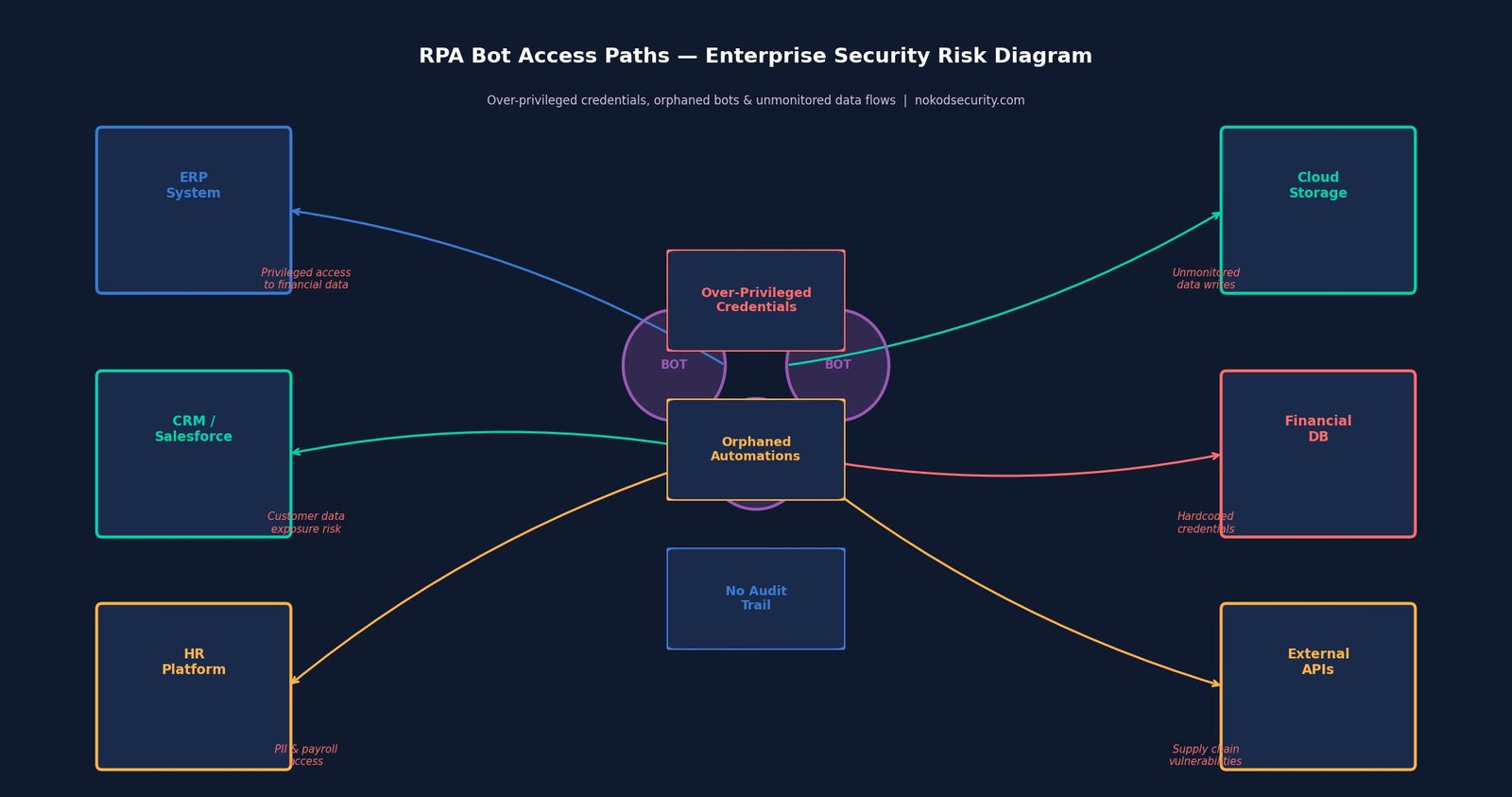
RPA bots occupy an unusual position in the enterprise security landscape. They are software – and therefore subject to all the vulnerability risks of any enterprise application. But they are also trusted actors within enterprise systems: they log in to applications, access databases, execute transactions, and handle sensitive data with credentials that are often highly privileged.
This combination – software with the access rights of a trusted human user – creates a security risk profile that is distinct from both traditional applications and from the human users whose actions they automate. Key risks include:
- Privileged credential exposure: RPA bots require credentials to access the systems they automate. These credentials are frequently stored insecurely – embedded in bot scripts, stored in configuration files, or shared across multiple bots – creating a persistent exposure risk that is difficult to audit and remediate.
- Principle of least privilege violations: Bots are often granted broad access to make the automation easier to build. The result is bots running with far more privilege than their function requires – a violation of basic security hygiene that creates significant blast radius if a bot is compromised or misbehaves.
- Orphaned automations: When the employee who built or managed a bot moves on, the bot typically continues running. Orphaned bots – operating under accounts or credentials that no one is actively managing – represent a persistent, unmonitored risk.
- Injection vulnerabilities: Bots that process unstructured inputs – such as email content, document text, or form submissions – can be vulnerable to injection attacks that cause them to behave in unintended ways.
- Audit trail gaps: Traditional security monitoring is designed to track human user activity. Automated bot activity may not be captured in the same audit logs, creating blind spots in incident investigation and compliance reporting.
- Supply chain risks: Bots that integrate with external systems, APIs, or third-party services introduce supply chain dependencies that may carry their own security vulnerabilities.
The Citizen Developer Dimension
The security challenges of RPA are significantly amplified by the shift toward citizen development – the phenomenon of non-technical business users building automations and bots themselves, outside the formal software development process.
Citizen developers are not security professionals. They are operations managers, finance analysts, HR coordinators, and customer service leads who have learned to use RPA tools to solve their own workflow problems. They are motivated by efficiency, not security. They make decisions about credential storage, access permissions, and data handling based on what makes the automation work, not what makes it secure.
The result is a long tail of citizen-built automations that collectively represent a significant and largely unmanaged attack surface. A single large enterprise may have hundreds or thousands of these automations running across its environment, most of them unknown to the security team, many of them carrying credentials with more access than they need, and some of them no longer actively maintained by anyone.
Research on enterprise citizen development and its governance implications is well-documented. The IEEE Computer Society has published extensively on the governance challenges that arise when software development is democratized beyond professional developers.
How the Market Is Addressing RPA Security
The RPA security market is still maturing. Platform vendors have introduced native security features – UiPath, for example, offers credential management through its Orchestrator platform, and Automation Anywhere has built governance controls into its Cloud platform. These native features are valuable but have meaningful limitations: they are platform-specific, they require significant configuration to be effective, and they do not address the growing volume of RPA capabilities embedded in broader no-code platforms like Power Automate.
The broader security industry has begun to develop dedicated solutions for the automation security problem. Privileged Access Management (PAM) vendors have added bot identity capabilities. SIEM platforms have created analytics rules for detecting anomalous bot behavior. Identity governance tools have extended their coverage to service accounts used by RPA systems.
But none of these approaches addresses the fundamental challenge of governing citizen-built automations across heterogeneous platforms with a unified view, continuous monitoring, and actionable remediation guidance.
Nokod Security: Enterprise-Grade Governance for Automation Security
Nokod Security’s approach to automation security is built on the recognition that the RPA problem cannot be solved platform by platform or control by control. What enterprises need is comprehensive visibility across all their automation assets – regardless of which platform they were built on – combined with continuous security analysis and practical remediation pathways.
Nokod supports UiPath as part of its multi-platform coverage, automatically discovering and mapping automations, analyzing them for security risks, and surfacing findings with the context security teams need to understand and prioritize what they are looking at. The platform identifies the specific risk patterns that characterize enterprise RPA environments: over-privileged credentials, injection vulnerabilities, orphaned automations, insecure data handling, and unsanctioned external integrations.
A critical aspect of Nokod’s approach is its recognition that the security team is not the only actor who needs to take action. Many of the remediations for common RPA security findings need to be carried out by the citizen developers or business owners who built the automations. Nokod is designed to enable this: security findings are surfaced with clear, actionable guidance that business users can understand and act on, and where possible, one-click remediation options eliminate the need for developer expertise.
Building a Citizen Developer Governance Framework
Organizations that want to address the security risks of citizen development at scale need more than tooling alone – they need a governance framework that defines how citizen developers are expected to operate, what guardrails are in place, and how security oversight is maintained without killing the agility that makes citizen development valuable.
Key components of an effective citizen developer governance framework include:
- Inventory and discovery: You cannot govern what you cannot see. Continuous, automated discovery of all citizen-built assets is the foundation of any governance program.
- Risk classification: Not all citizen-built automations carry equal risk. A framework for rapidly classifying automations by risk level – based on data sensitivity, external exposure, and privilege level – enables proportionate oversight.
- Security standards: Clear, practical security standards for citizen developers – covering credential management, data handling, testing, and documentation – must be communicated in terms that non-technical builders can understand and follow.
- Ownership and lifecycle management: Every automation should have a designated owner, and governance processes should trigger reviews when owners change roles or leave the organization.
- Continuous monitoring: Governance cannot be a one-time audit. Continuous monitoring for new assets, configuration changes, and behavioral anomalies is essential.
Conclusion
The automation revolution driven by RPA and citizen development has delivered real value – and it is not going away. Enterprises will continue to expand their automation footprint, and the volume of citizen-built automations will continue to grow. The question is not whether to embrace this trend, but how to do so without accepting a security risk that is invisible, unmanaged, and growing.
Effective citizen developer governance requires acknowledging that the people building these automations are not security experts – and building programs and platforms that meet them where they are. Nokod Security’s approach, which combines deep AppSec expertise with practical tooling designed for both security professionals and business users, represents a model for how enterprises can have both the speed of citizen development and the security governance that responsible enterprise operations require.
Business Solutions
Efficient Construction Waste Management: 5 Methods and ConWize Software Solution
Are you tired of the inefficiencies and headaches that come with managing construction waste? Look no further! In this blog post, we will explore five proven methods for efficient construction waste management, as well as introduce you to ConWize Software Solution – a game-changing tool designed to streamline the process. Say goodbye to wasted time and resources, and hello to a more sustainable and profitable construction site. Let’s get started!
In the realm of construction, effective waste management is paramount to ensure sustainability and cost-effectiveness throughout projects. Among various solutions available, ConWize construction bidding software emerges as a top-tier option, offering unparalleled efficiency and accuracy in waste management estimation. In this comprehensive guide, we explore five proven methods for managing construction waste and emphasize the benefits of integrating ConWize construction waste management software into waste management practices.
Method 1: Source Reduction and Prevention
Source reduction techniques aim to minimize waste generation from the outset of a construction project. These strategies, such as prefabrication and modular construction, optimize material usage, resulting in significant reductions in waste. By implementing source reduction practices, construction companies can not only cut costs but also alleviate the environmental burden associated with excessive waste disposal.
Implementing source reduction strategies requires careful planning and collaboration among project stakeholders. Design teams can explore innovative approaches to minimize material waste, while construction managers oversee the implementation of these strategies on-site. By prioritizing source reduction and prevention, construction projects can achieve greater efficiency and sustainability from the onset.
Method 2: Recycling and Reusing Materials
Recycling and reusing materials offer a sustainable solution to divert construction waste from landfills. Common materials like concrete, wood, and metals can be recycled or repurposed for other projects. Recycling facilities process these materials into new products, reducing the need for virgin resources and minimizing environmental impact.
Engaging in recycling and reuse initiatives requires coordination with recycling facilities and waste management providers. Construction companies must establish protocols for segregating and collecting recyclable materials on-site. Additionally, educating project teams on the importance of recycling and promoting sustainable practices fosters a culture of environmental responsibility within the organization.
Method 3: Waste Segregation and Sorting
Waste segregation and sorting are fundamental steps in effective waste management. By categorizing waste streams on-site, construction companies can streamline recycling and proper disposal processes. Segregating materials such as concrete, metal, and plastics ensures that each type can be managed appropriately, optimizing resource recovery and minimizing waste sent to landfills.
Implementing waste segregation practices requires clear communication and consistent enforcement of segregation protocols. On-site supervisors and waste management teams play a crucial role in overseeing waste sorting activities and ensuring compliance with regulations. By investing in training and providing adequate resources, construction companies can enhance waste segregation practices and maximize recycling efforts.
Method 4: On-Site Waste Treatment
On-site waste treatment offers an alternative to traditional waste disposal methods, allowing construction companies to process waste directly at the project site. Techniques such as composting and incineration can effectively manage organic and non-recyclable waste streams. By treating waste on-site, construction projects minimize transportation costs and reduce environmental impact.
Implementing on-site waste treatment systems requires careful consideration of site-specific factors and regulatory requirements. Construction companies must assess the feasibility of different treatment options based on project size, location, and waste composition. Additionally, monitoring and maintenance protocols ensure the proper functioning of waste treatment facilities throughout the project duration.
Method 5: Implementing Digital Solutions like ConWize Software
Integrating digital solutions like ConWize construction estimation software revolutionizes construction waste management practices. ConWize utilizes advanced algorithms and data analytics to streamline waste estimation processes with unparalleled accuracy and efficiency. By centralizing waste management data and automating calculations, ConWize empowers construction companies to optimize waste management strategies and achieve cost savings.
The implementation of ConWize software begins with comprehensive training and onboarding for project teams and stakeholders. Construction companies can customize the software to align with their specific waste management workflows and project requirements. Additionally, ongoing support and updates ensure that ConWize remains a valuable tool for enhancing waste management practices throughout the project lifecycle.
Case Studies: Successful Implementation of ConWize Software
Numerous construction companies have experienced remarkable success with ConWize software, achieving significant reductions in waste generation and disposal costs. Case studies demonstrate how ConWize streamlines waste estimation, enhances project efficiency, and improves overall sustainability. By leveraging ConWize’s features and capabilities, construction companies have overcome waste management challenges and achieved measurable results.
Comparison with Other Waste Management Solutions
When evaluating waste management solutions, ConWize stands out for its comprehensive features, user-friendly interface, and unparalleled accuracy. Compared to other tools available in the market, ConWize offers superior functionality and flexibility, making it the preferred choice for construction professionals. By conducting a thorough comparison of available options, construction companies can make informed decisions and choose the solution that best meets their waste management needs.
Challenges and Considerations
Despite the numerous benefits of construction waste management practices, challenges may arise during implementation. Factors such as workforce training, regulatory compliance, and technological integration require careful consideration and planning. Construction companies must address these challenges proactively to ensure the successful adoption of waste management practices, including the integration of ConWize software into existing workflows.
Efficient construction waste management is essential for sustainable and cost-effective project outcomes. By embracing methods such as source reduction, recycling, and waste segregation, construction companies can minimize environmental impact and maximize resource efficiency. Additionally, integrating innovative solutions like ConWize software enhances waste management processes, leading to improved accuracy, efficiency, and project sustainability. Embracing these strategies and tools is key to achieving success in construction waste management and advancing towards a more sustainable future.
FAQ for Efficient Construction Waste Management: 5 Methods and ConWize Software Solution
- What is ConWize construction estimation software, and how does it benefit construction waste management?
-
-
- ConWize is advanced software designed to streamline waste estimation processes in construction projects. It utilizes algorithms and data analytics to accurately estimate waste generation, optimize waste management strategies, and ultimately reduce costs and improve project efficiency.
-
- How does source reduction differ from other waste management methods, and why is it important?
-
-
- Source reduction focuses on minimizing waste generation from the beginning of a construction project by optimizing material usage and employing innovative construction techniques like prefabrication and modular construction. It is crucial because it addresses waste at its source, leading to significant cost savings and environmental benefits.
-
- What are the key benefits of on-site waste treatment, and how does it contribute to sustainable construction practices?
-
-
- On-site waste treatment offers several benefits, including reduced transportation costs, minimized environmental impact, and enhanced resource efficiency. By treating waste directly at the project site through techniques such as composting and incineration, construction companies can achieve greater sustainability and cost-effectiveness.
-
- How does ConWize software compare to other waste management solutions available in the market?
-
-
- ConWize stands out for its comprehensive features, user-friendly interface, and unparalleled accuracy in waste estimation. Compared to other tools, ConWize offers superior functionality and flexibility, making it the preferred choice for construction professionals seeking to optimize waste management practices.
-
- What are some common challenges construction companies may face when implementing waste management practices, including the integration of ConWize software?
-
- Challenges may include workforce training, regulatory compliance, and technological integration. However, with proper planning and proactive measures, construction companies can overcome these challenges and successfully adopt waste management practices, including the seamless integration of ConWize software into their workflows.

Edge AI Explained: How On-Device AI Processing Is Replacing the Cloud
The Rise of System-in-Package (SiP): How Advanced IC Packaging Is Redefining Electronics Miniaturization
Wire Bonding vs. Flip Chip: Navigating the Evolving World of IC Interconnect Technology

-
Business Solutions2 years ago
Understanding A2P Messaging and the Bulk SMS Business Landscape
-

 Business Solutions2 years ago
The Power of Smarts SMS and Single Platform Chat Messaging
-

 Business Solutions2 years ago
Exploring OTP Smart Features in Smart Messaging Services
-

 Business Solutions2 years ago
Live Video Broadcasting with Bonded Transmission Technology
-

 Business Solutions1 year ago
The Future of Healthcare SMS and RCS Messaging
-

 Business Solutions2 years ago
2-Way Texting Solutions from Company Message Services
-

 Business Solutions2 years ago
Communication with Analog to Fiber Converters & RF Link Budgets
-

 Business Solutions2 years ago
B2B vs. B2C Content Creation: Tailoring Your Message to Win the Deal