


Business Solutions
CSP Future: Smart IoT Gateway and New-Age Network Assurance


Picture a city that never sleeps, not because it’s too busy to rest, but because everything from its streetlights to its factories is seamlessly monitored and optimized. In this living network of devices, network service assurance for CSP merges with a smart iot gateway to orchestrate real-time data flows, reinforce security protocols, and anticipate disruptions before they happen. By blending localized processing, deep analytics, and robust protection measures, providers create an environment that evolves on its own, quietly recalibrating capacity and detecting anomalies to maintain uninterrupted service.
It’s a vision that transforms the once-static world of connectivity into an agile, self-correcting ecosystem. Instead of waiting for a problem to occur, operators deploy automated tools and AI-driven strategies that spot weak signals or traffic imbalances early. At the same time, a gateway deployed on-site manages edge intelligence, filtering out noise and securing critical data without flooding the central network. For communication service providers, this convergence of orchestrated assurance and localized computing represents a powerful way to retain control, maximize performance, and innovate continuously.
Shifting the Connectivity Paradigm
Gone are the days when connectivity only meant ensuring basic phone and internet services. Today’s technologies have woven themselves into the fabric of daily life—smart thermostats adjust temperatures based on real-time weather data, autonomous robots maneuver through warehouses, and entire cities rely on predictive maintenance to keep utilities online. The pressure on CSPs has grown proportionately. They no longer just manage bandwidth or guarantee a dial tone; they must ensure a level of responsiveness and stability that can handle massive device populations and continuous data flows.
This shift demands that CSPs focus on something more holistic than mere uptime. They need a broad perspective—one that merges raw connectivity with proactive insights. If a significant outage occurs at a single base station, thousands of sensors might go silent, halting everything from logistics to public safety operations. The cost of such a disruption isn’t just about lost data; it’s about eroding trust in technologies that increasingly guide mission-critical processes.
Enter the idea of network service assurance for CSP, a framework that relentlessly monitors and fine-tunes network health. It gathers key metrics from every node, evaluating latency, bandwidth usage, security threats, and device performance. Instead of passively reporting on issues, advanced assurance systems make micro-adjustments behind the scenes to avert major breakdowns. Layer in edge intelligence from a smart iot gateway, and you get a cohesive approach that unites localized decision-making with end-to-end oversight.
Elevating the Role of the Gateway
At first glance, the gateway might seem like a small cog in the vast machine of communication networks. But in truth, it functions as the local command center, bridging thousands of devices to the wide-area infrastructure. Where traditional gateways merely forwarded data to the cloud, the modern gateway also integrates computing power, secure storage, and on-device analytics. By doing so, it offloads much of the processing from central servers, reduces bandwidth use, and accelerates event responses.
In a manufacturing plant, for instance, dozens of sensors might track machinery vibrations, temperature fluctuations, and component wear. A smart iot gateway can rapidly correlate these readings, spotting any anomalies that hint at impending equipment failure. Before the issue escalates to a shutdown, it can send an alert to on-site technicians or automatically modify operating parameters. Meanwhile, essential insights flow to a broader assurance platform, which sees the big picture across multiple plants and can decide how to redistribute resources or whether to reorder spare parts in anticipation of maintenance needs.
Security also gets a significant boost. Gateways often function as the first line of defense, applying encryption keys, enforcing device authentication, and scanning for odd traffic patterns. If a sensor starts sending malformed packets or an unauthorized device attempts to connect, the gateway can isolate that threat before it spreads. With an advanced assurance system monitoring overall network health, suspicious actions become part of a real-time security picture that extends from the edge to the core.
Reinventing Network Assurance
In the old model, service assurance was a reactive affair. Tools recorded metrics in the background and triggered alarms when some threshold was exceeded. Administrators then scrambled to diagnose and fix the glitch. This approach might have been acceptable for smaller networks, but not for a world with billions of IoT devices. Delays of even a few minutes can send ripples of downtime through numerous connected systems.
That’s why network service assurance for CSP has shifted toward proactive and even predictive methods. Machine learning models analyze normal operating patterns, memorizing how the network behaves at different times of day, or under specific loads. They can detect subtle deviations—like an uptick in packet loss or an increase in CPU usage that isn’t yet critical but could become so in the near future. In response, they rebalance traffic, reassign network slices, or alert technicians to verify potential problems.
Such intelligence thrives when an on-site gateway delivers granular insights. If the gateway logs a sudden surge in sensor traffic from one corner of a facility, the assurance platform immediately understands context. It recognizes whether this is a legitimate spike—perhaps from a batch process ramping up—or an anomaly hinting at a malfunction. The collaboration means quick decisions can be made locally while the overarching system sets broader policies, ensuring the entire operation remains steady and flexible enough to adapt to changing demands.
Orchestrating Edge and Core
The conversation about distributed computing versus centralized architectures once felt like an all-or-nothing debate. Either you push data to the cloud or keep everything on local servers. However, the synergy between a smart iot gateway and a robust assurance platform brings a nuanced approach. By splitting responsibilities intelligently, networks can scale far beyond what an entirely centralized model could handle.
In large industrial sites, the gateway might analyze sensor readings in real time for safety-critical tasks—like shutting down a machine when it overheats. At the same time, aggregated metrics flow upward for historical analysis, capacity planning, or advanced troubleshooting. This layered orchestration ensures that urgent tasks see minimal latency, while big-picture analytics can still benefit from cloud-scale resources and AI algorithms. It also provides a failsafe: if a connection to the cloud is lost, local systems keep functioning.
Such orchestration becomes especially powerful when integrated with technologies like software-defined networking (SDN) and network slicing. The gateway can inform the central controller if it detects surges in sensor data, prompting the system to allocate extra bandwidth or reconfigure routes. Meanwhile, critical applications like emergency services could receive priority on designated slices. The result is a fluid, adaptable network that thrives under fluctuating conditions.
Addressing Real-World Complexity
Anyone who’s tried implementing large-scale IoT knows that real-world conditions can disrupt even the best blueprints. A remote wind farm might have limited connectivity options or face harsh weather conditions. An urban environment might suffer from RF interference or building obstructions. In many industries, legacy systems still operate with archaic protocols that don’t natively mesh with modern IoT standards.
This is where the gateway’s ability to translate and unify protocols becomes indispensable. It can accommodate older equipment and speak to cutting-edge devices alike, ensuring all data passes securely into the network service assurance for CSP domain. Meanwhile, because it handles encryption and local analytics, the gateway helps each site function with a degree of independence, even if central links falter.
Maintenance is another key hurdle. Keeping hundreds—or thousands—of gateways up to date with the latest firmware and security patches can feel like an impossible chore. However, an advanced assurance framework can automate these updates, dispatching over-the-air instructions whenever they detect vulnerabilities or performance improvements. By tracking versions, verifying digital signatures, and ensuring minimal downtime, the system keeps everything in sync while minimizing manual effort.
Collaboration and Ecosystem Building
No single entity can provide every piece of the puzzle. Success emerges from partnerships among sensor manufacturers, networking hardware companies, software vendors, and CSPs. These parties come together to define communication standards, refine security protocols, and test new hardware against real-world conditions. Ecosystems of solutions develop, ensuring that any newly designed IoT sensor or application can integrate seamlessly into existing infrastructure.
Many CSPs run innovation labs or partner with universities to prototype advanced gateway features and trial them in controlled environments. Others sponsor developer communities where third-party experts can add capabilities to gateway firmware or create specialized analytics modules. This open ecosystem approach accelerates innovation. When a new sensor technology appears, gateway manufacturers and CSPs can quickly integrate it, verifying compliance with the broader assurance platform to avoid compromising reliability or security.
Such collaboration also fosters confidence among enterprise customers. Whether it’s a logistics firm deploying asset trackers across continents or a city scaling up an entire suite of connected infrastructure, they want assurance that each component meets rigorous standards. By pooling expertise, the industry reduces friction and paves the way for smoother adoption of IoT technologies worldwide.
Innovations Shaping Tomorrow
With 5G and beyond on the horizon, the potential for transformation grows exponentially. High-speed, low-latency links open the door for real-time video analytics, robot swarms in logistics, and a plethora of consumer-facing experiences that rely on instant feedback. Meanwhile, gateways stand poised to receive more sophisticated AI capabilities, enabling them to anticipate changes in local environments and reorder tasks autonomously.
Quantum-safe encryption might become a standard feature, especially for industries concerned about the long-term security of their data. Blockchain-based identity management could guard against impersonation attacks, verifying device authenticity at each handshake. As these advanced concepts gain traction, network service assurance for CSP will have to expand its scope, monitoring not just performance but also adherence to stringent security and privacy requirements across millions of connected endpoints.
In some cutting-edge scenarios, the gateway might even shift from a stationary node to a mobile one—embedded in vehicles, drones, or wearable technologies that demand immediate data processing. Assurance systems would track these roving endpoints, allocating resources in real time so that connectivity remains robust no matter where or how the device moves. This level of flexibility redefines the boundaries of what’s possible in a connected world.
Pioneering a Resilient, Adaptive Future
Viewed in its entirety, the alliance between a smart iot gateway and advanced network service assurance for CSP signals a bold step forward. It rebalances the flow of data between edge and core, ensuring real-time responsiveness alongside holistic oversight. In an era when entire industries hinge on continuous connectivity, even a short disruption can cost millions—or worse, threaten public safety. The path toward stability lies in combining local intelligence with global orchestration.
From telemedicine in remote villages to vast energy grids that power entire nations, connectivity remains the glue holding the modern world together. And as demands climb for faster data, stringent security, and unerring reliability, the gateway becomes more than just another router. It’s the nerve center that ensures each device, sensor, or system contributes to a collective tapestry of insights. Meanwhile, the assurance platform monitors the entire operation like a skilled conductor, harmonizing processes to achieve seamless, near-invisible performance.
Looking ahead, the trajectory is clear. The rise of self-driving vehicles, automated factories, connected agriculture, and even space-based IoT networks will drive continuous refinements. In this unstoppable tide of innovation, only those who master the synergy of localized edge intelligence and proactive, predictive assurance can fully unlock the potential of the hyperconnected era. By embracing this model now, CSPs and enterprises alike position themselves to not just endure the changes ahead, but to flourish within them, crafting the next generation of services that truly redefine how we connect, compute, and collaborate on a global scale.


Business Solutions
Optical Delay Lines: The Precision Solution Reshaping Radar and Altimeter Testing

Summary: Radar and altimeter systems must be rigorously tested and calibrated before deploymen-but transmitting live RF energy to simulate target returns is impractical, hazardous, and often impossible in a laboratory or depot environment. This article explains how optical delay lines (ODLs) solve this fundamental challenge, how they work, why fiber-based delay lines outperform electronic alternatives, and how RFOptic’s specialized ODL solutions support radar and altimeter testing programs across defense and aviation markets.
Radar and altimeter testing is one of the most technically demanding areas in defense electronics validation. Systems must be verified to perform accurately across a range of simulated target distances, velocities, and environments-yet doing so by physically placing reflecting targets at the required distances is seldom feasible. The solution lies in optical delay lines, a technology that uses the fixed propagation speed of light in optical fiber to introduce precisely controlled time delays into an RF signal, simulating the time-of-flight of a radar return at a specified range.
The Testing Problem: Why You Cannot Simply Transmit to a Real Target
A radar system determines the range of a target by measuring the round-trip time of a transmitted pulse. An altimeter determines altitude by measuring the time for the transmitted signal to reflect off the ground and return. In both cases, the fundamental measurement is time-of-flight -and testing this measurement requires introducing a known, accurate delay between the transmitted signal and the simulated return.
In field testing, this can be done by physically placing a reference reflector at a known distance. But field testing is expensive, weather-dependent, logistically complex, and often impossible for airborne altimeters (which would require flight testing to validate each range point) or for classified radar systems that cannot be operated in environments where frequency emissions are monitored or regulated. Depot-level maintenance and factory acceptance testing require a bench solution.
Electronic delay lines-switched networks of lumped inductors and capacitors, or surface acoustic wave (SAW) devices-have historically been used for this purpose. But they carry significant limitations: limited frequency range, high insertion loss, temperature-dependent performance, and the inability to cover the multi-microsecond delays needed to simulate distant targets without cascading multiple stages and accumulating noise and distortion.
How an Optical Delay Line Works
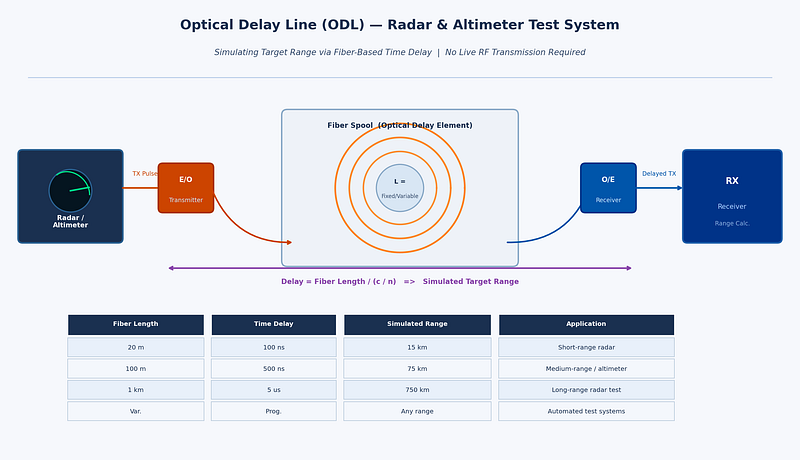
An optical delay line converts the RF signal to be delayed into an optical signal using an electro-optic modulator or laser diode, routes that optical signal through a calibrated length of single-mode optical fiber, then reconverts it back to an RF signal at the output using a photodetector. Since light travels through fiber at approximately 2×1⁰⁸ meters per second (about two-thirds of the speed of light in vacuum), a specific fiber length produces a very precise and stable delay.
For example, approximately 100 meters of fiber produces a delay of around 500 nanoseconds-equivalent to a radar range of approximately 75 kilometers in a monostatic radar configuration. Variable delay lengths can be achieved through switched fiber spools, allowing test equipment to simulate targets at multiple programmable ranges without moving any physical hardware.
The key performance advantages of fiber-based delay lines compared to electronic alternatives are:
• Extremely low loss: optical fiber introduces negligible signal loss per unit length compared to coaxial cable or electronic delay elements at microwave frequencies.
• Frequency independence: the delay is determined purely by the fiber length, not the frequency of the signal. The same ODL works equally well at 1 GHz and at 40 GHz, making it suitable for multi-band radar and wideband altimeter testing.
• Excellent phase stability: fiber delay is not affected by electromagnetic interference and shows very low thermal drift compared to electronic delay networks.
• Scalability: very long delays (microseconds to tens of microseconds) equivalent to hundreds or thousands of kilometers of range-are achievable simply by using more fiber, without cascading lossy electronic stages.
• Electrical isolation: optical fiber passes no DC current and provides complete galvanic isolation between the input and output RF ports, eliminating common-ground interference paths in complex test setups.
Variable and Programmable Optical Delay Lines
The most operationally useful ODL systems offer variable or programmable delay-the ability to switch between multiple discrete delay values to simulate different target ranges. This is achieved through optical switching networks that connect the RF signal to different fiber spools of different lengths, or through continuous variable delay mechanisms using motorized fiber stretchers or optical path length adjustment.
Programmable delay lines are essential for acceptance testing of radar systems that must perform across the full specified range envelope. Rather than resetting physical hardware for each range point, the test engineer selects the desired delay from the ODL’s control interface, and the system switches to the appropriate fiber path within milliseconds. For automated production test environments, this enables rapid, software-controlled multi-point range calibration.
According to the IEEE Transactions on Microwave Theory and Techniques, optical delay line technology has advanced considerably with the integration of programmable switching and temperature compensation, making modern ODL systems suitable for demanding calibration environments where measurement uncertainty must be minimized.
Altimeter Testing: A Specialized Requirement
Radio altimeters-used in commercial aviation, military aircraft, and UAVs to measure height above terrain-are safety-critical systems with stringent testing requirements. Regulatory bodies including the FAA and EASA require verification of altimeter accuracy across the full operating altitude range, typically from near-zero to several thousand feet. Testing each altitude point requires introducing the corresponding time delay between the transmitted altimeter signal and the simulated ground return.
Modern radar altimeters typically operate in the 4.2–4.4 GHz frequency band, though next-generation systems and those for unmanned platforms span wider ranges. Key testing parameters include:
• Absolute accuracy: the altimeter must measure altitude to within a defined tolerance across the full range.
• Response time: the altimeter must update its reading within a specified latency when altitude changes rapidly-important for terrain-following and automatic landing systems.
• Interference immunity: with 5G networks now deployed in the 3.7–4.2 GHz C-band in many countries, regulatory concerns about altimeter interference have made test coverage of adjacent-band interference scenarios a new requirement.
An optical delay line test system for altimeter applications must cover the altimeter’s full altitude range (typically equivalent to delays from a few to several hundred nanoseconds), handle the altimeter’s specific frequency band, and provide calibrated, repeatable delay values. For aircraft integration testing, the system must also operate reliably in the electromagnetic environment of an avionics test bench.
RFOptic’s Optical Delay Line Solutions
RFOptic offers customized low and high frequency optical delay line solutions for testing and calibrating radar and altimeter systems. The company’s ODL product line is described as one of its core competencies, offering both standard and application-specific configurations.
RFOptic provides both fixed and programmable delay configurations, with the following key characteristics as described on their platform:
• Coverage from low frequency through high-frequency microwave and mmWave bands, supporting both current-generation radar and altimeter systems and next-generation wideband applications.
• Customized ODL systems developed to customer specifications, including integration with specific test equipment interfaces and control software.
• Online request-for-quote tool for customized ODL and altimeter ODL systems, supporting design consultation from the earliest project stage.
• Subsystem integration: RFOptic’s ODLs can be integrated into complete radar and altimeter test subsystems, combining the delay function with signal conditioning, switching, and management interfaces.
RFOptic’s value proposition emphasizes that in the pre-sales stage, the company builds solutions tailored to customer needs, including simulations that predict link behavior-particularly important for ODL systems where target delay accuracy and dynamic range must be verified analytically before hardware is built.
Emerging Applications: UAV Altimeters and Radar Testing
The rapid growth of unmanned aerial systems (UAS/UAV) has created a new generation of altimeter testing requirements. Drone altimeters are smaller, lighter, and often operate in different frequency bands than traditional aviation altimeters. They must be validated for low-altitude terrain-following, precision landing approaches, and operation in spectrum-contested environments. The same fundamental principle applies: fiber-based optical delay lines provide the most accurate and flexible platform for simulating the required altitude ranges in a laboratory setting.
For those evaluating radar testing solutions, the combination of programmable delay ranges, wide frequency coverage, and low noise floor that optical delay lines provide makes them the reference tool of choice across military radar, commercial aviation, and UAV development programs.
Conclusion
Optical delay lines represent a technically elegant solution to one of the oldest problems in radar and altimeter development: how to test time-of-flight accuracy without deploying hardware into the field. By leveraging the fixed and stable propagation speed of light in optical fiber, ODL systems deliver highly accurate, repeatable, and frequency-independent delay values that electronic alternatives cannot match at microwave and mmWave frequencies.
For radar system developers, avionics test labs, and depot maintenance facilities, investing in optical delay line test equipment-particularly programmable systems capable of simulating multiple range points-is a practical step that reduces test time, improves calibration accuracy, and future-proofs the test infrastructure for next-generation wideband radar and altimeter systems.
Summary: As 5G networks push into the millimeter-wave (mmWave) frequency bands, the challenge of accurately testing these systems in a laboratory environment has grown dramatically. This article examines the unique testing demands of 5G FR2 mmWave devices, why traditional coaxial test setups struggle at these frequencies, and how RF over fiber technology enables more accurate, repeatable, and scalable 5G test environments. It also outlines how RFOptic’s purpose-built RFoF solutions address the needs of 5G/6G testing engineers worldwide.
The global rollout of 5G networks represents one of the most complex RF engineering challenges in telecommunications history. For the test and measurement community, it has introduced equally demanding new requirements – particularly as deployments move into the mmWave spectrum. Engineers evaluating whether their test infrastructure is ready should start with a foundational question: can your signal transport method keep up with the frequencies you are testing? Exploring rf over fiber technology is increasingly the answer that test labs are arriving at.
Understanding 5G FR2: The mmWave Challenge
5G is defined by two frequency ranges. FR1 covers the sub-7 GHz bands familiar from 4G LTE, while FR2 – often called mmWave 5G – covers bands from approximately 24.25 GHz up to 52.6 GHz in the current 3GPP standard framework, with future extensions anticipated beyond 100 GHz for 6G precursor research. These FR2 bands offer multi-gigahertz of contiguous spectrum, enabling peak data rates measured in gigabits per second and ultra-low latency performance that FR1 alone cannot deliver.
However, mmWave signals propagate very differently from sub-6 GHz RF. They are attenuated much more rapidly in air, blocked by building materials, and absorbed by the body of a device under test. This means 5G mmWave devices almost universally rely on beamformed, phased array antenna systems – integrated directly into the device – that electronically steer a narrow beam to maintain link quality.
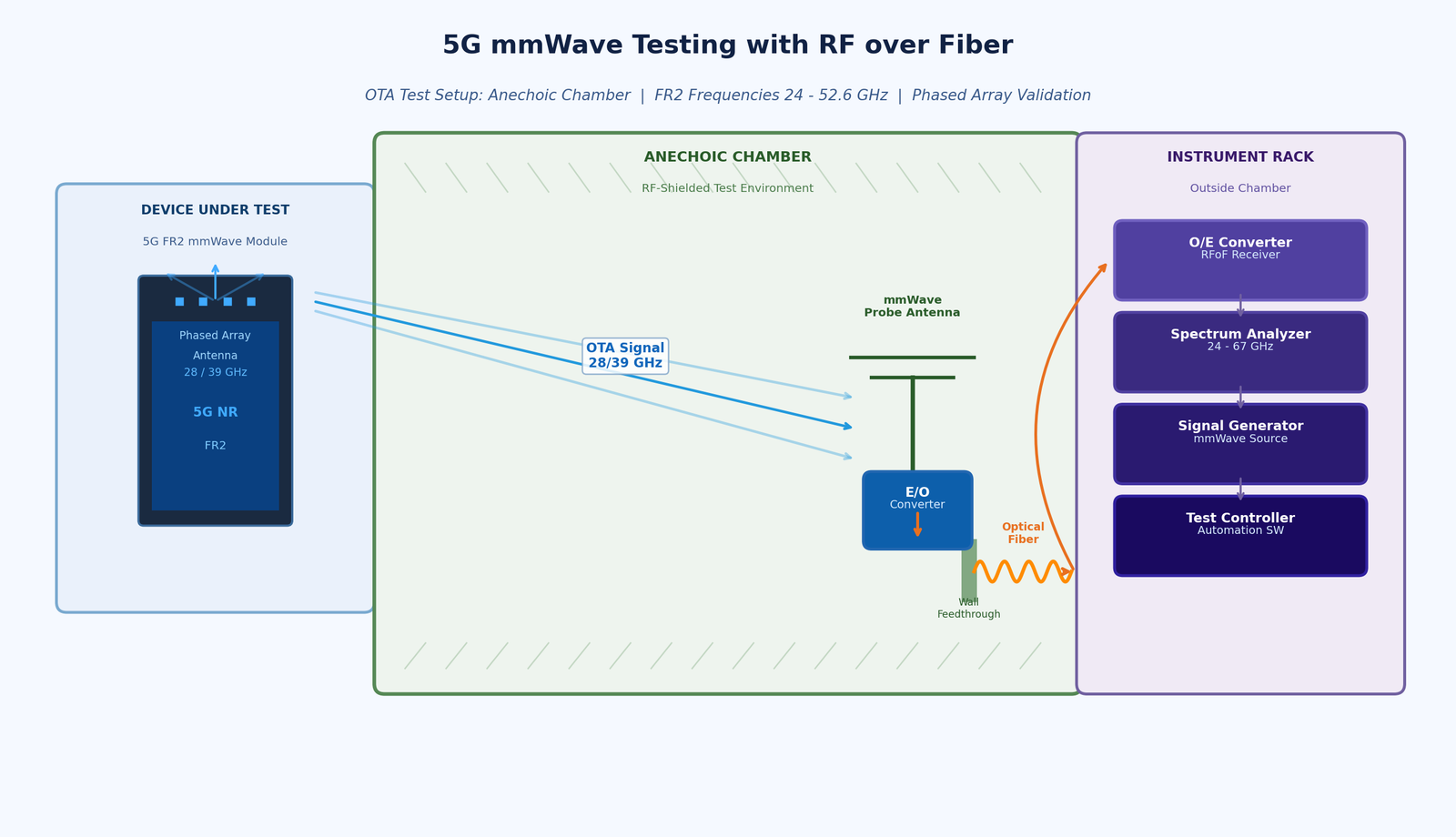
For test engineers, this creates a significant problem: these integrated antenna arrays cannot be physically connected to a test instrument via a coaxial cable. Testing must be done over the air (OTA) – meaning the device radiates its signal in free space, and test instruments must receive and analyze the radiated field. This in turn demands anechoic or semi-anechoic chamber environments, precise positioning, and signal transport from the antenna probe in the chamber to the instrument rack outside it.
The 3GPP’s technical specifications for 5G OTA testing are detailed in the TS 38.521 and TR 38.810 documents, which outline measurement configurations for FR2 devices. 3GPP Technical Specifications provide the industry baseline against which all 5G OTA test methodologies are validated.
Why Coaxial Cable Fails the 5G FR2 Test
At sub-6 GHz frequencies, the losses introduced by a coaxial cable between a test antenna and an instrument are manageable. At 28 GHz or 39 GHz, they are not. Signal attenuation in standard coaxial cables at mmWave frequencies is dramatically higher – often 2 to 4 dB per meter or more at Ka-band frequencies, depending on cable diameter. For a test setup with antenna probes positioned several meters from the instrument, this means severe signal degradation.
The consequences are measurable and serious:
- Higher noise floor in the measurement system, reducing sensitivity and making it harder to detect weak signals from the device under test.
- Reduced dynamic range, preventing the system from characterizing both strong and weak signals in the same measurement sweep.
- Phase instability due to coax mechanical sensitivity — even bending a cable can shift its phase response, introducing errors in phase-sensitive measurements like EVM (Error Vector Magnitude).
- Impractical cable management: at mmWave frequencies, even small connectors introduce insertion losses and mechanical fragility becomes a reliability concern in frequently reconfigured test environments.
- Fundamental frequency limits of most coaxial assemblies make coverage above 40 GHz an engineering challenge requiring specialized and expensive waveguide solutions.
RF over Fiber as the 5G Test Infrastructure Standard
RF over fiber addresses the signal transport problem in 5G FR2 test environments at the fundamental level. Instead of routing the mmWave signal through coaxial cable, RFoF converts it to an optical signal immediately at the antenna probe and transports it over optical fiber to the instrument. Optical fiber has negligible attenuation in the relevant transmission windows (on the order of 0.3 dB/km), is completely immune to electromagnetic interference, and does not introduce phase errors due to bending or temperature changes.
For 5G test labs, this translates to practical advantages:
- Probe-to-instrument distances of tens of meters or more with minimal signal degradation – enabling large anechoic chambers and flexible test geometries.
- Consistent signal integrity that enables accurate, repeatable measurements across multiple test runs and different environmental conditions.
- Freedom from EMI: test chambers often house high-power amplifiers, switching equipment, and other RF sources. Fiber is immune to all of this.
- Simplified test cell design: replacing bundles of mmWave coaxial assemblies with a single fiber link dramatically reduces installation complexity.
RFOptic’s Role in 5G/6G Testing
RFOptic’s stated mission is to provide state-of-the-art RF-optical solutions with superior performance to the 5G/6G testing emerging markets. The company describes itself as a solutions provider and R&D-driven innovative manufacturing company with global coverage and extensive experience with customized solutions for the 5G testing markets.
RFOptic offers what it describes as top-notch RF-over-glass commercial off-the-shelf products for civil 5G and defense applications. Key elements of their 5G testing product line include:
- Off-the-shelf RF over fiber links covering from DC to 67 GHz in three family groups, providing frequency coverage from well below FR1 through the complete FR2 band and into mmWave territory relevant for 6G research.
- HSFDR (High SFDR) links optimized for applications where spurious-free dynamic range and signal stability are paramount – exactly the conditions required for accurate 5G OTA measurements.
- Subsystems and end-to-end solutions per customer requirements, recognizing that 5G test labs often have specific chamber dimensions, device categories, and measurement configurations that require tailored signal transport architectures.
- Remote management: all links and subsystems are managed by local or remote management interface, supporting the integration of RFoF links into automated test system software environments.
RFOptic also provides an online RFoF link calculator tool to assist test engineers in predicting link performance parameters including noise figure, gain, and dynamic range for their specific configurations – enabling accurate test system planning before hardware deployment.
Anechoic Chambers and Remote Antenna Applications
One of the most direct 5G test applications for RFoF is the anechoic chamber setup. In this configuration, the test antenna (probe) is inside the shielded chamber, while the signal generator and analyzer are in the equipment rack outside. Connecting these requires passing the mmWave signal through the chamber wall – a location where coaxial feedthroughs introduce insertion loss, potential leakage, and EMI ingress.
RFOptic offers specific solutions for anechoic chamber applications, recognizing that this is a core use case in the 5G test environment. The optical fiber feedthrough eliminates the shield integrity problem and allows the full mmWave bandwidth to be transported without the frequency-dependent losses of coaxial alternatives.
Preparing for 6G: The Frequency Frontier
While 5G mmWave deployments are still in early phases in many markets, research and pre-standardization work on 6G has already begun at frequencies above 100 GHz – the D-band (110–170 GHz) and beyond. Test infrastructure being deployed today for 5G FR2 will increasingly need to serve as the foundation for 6G research environments.
Choosing RFoF solutions with frequency coverage well beyond the immediate 5G FR2 requirement provides a degree of future-proofing for test facilities. RFOptic’s product family, which extends to 67 GHz in its standard off-the-shelf range, positions test labs to expand measurement capability as 6G frequencies become relevant for device and system characterization.
Engineers specifying rf over fiber modules for 5G test infrastructure are therefore making a technology investment with a long useful life – particularly when the solution comes from a vendor with demonstrated capability well above the minimum required frequency and with a track record of supporting customized configurations.
Conclusion
The shift to 5G FR2 mmWave testing has fundamentally changed what test and measurement infrastructure must deliver. Signal transport between antennas and instruments across the 24–40 GHz range demands low loss, phase stability, EMI immunity, and scalability that coaxial cable cannot reliably provide. RF over fiber has become the standard solution for forward-thinking 5G test labs, and its role will only grow as the industry progresses toward 6G research frequencies.
For test engineers and lab managers evaluating their signal transport architecture, the key criteria are frequency coverage, dynamic range, phase consistency, and the availability of system-level support. Purpose-built RFoF solutions from experienced high-frequency vendors offer the complete package for today’s 5G test challenges and tomorrow’s 6G requirements.
Business Solutions
RPA Security Citizen Developer Governance: The Automation Risk Nobody Is Talking About
Summary: Robotic Process Automation (RPA) has become a cornerstone of enterprise digital transformation, enabling organizations to automate repetitive tasks at scale and free human workers for higher-value activities. But the widespread deployment of RPA bots – increasingly built by non-technical citizen developers rather than professional developers – has created a largely invisible security risk. From over-privileged bot credentials to unmonitored data flows and abandoned automations, the RPA attack surface is growing faster than most security programs can track. This article explores the key security risks in enterprise RPA environments, how citizen developer governance is evolving, and how purpose-built platforms are closing the gap.
The RPA Revolution and Its Security Shadow
Robotic Process Automation – the use of software bots to mimic human interactions with applications and automate repetitive business processes – has become one of the defining technologies of enterprise digital transformation over the past decade. From processing invoices and onboarding employees to reconciling financial data and managing IT service tickets, RPA bots now operate at the heart of critical business processes across virtually every industry.
The market for RPA has grown dramatically, with platforms like UiPath, Automation Anywhere, and Blue Prism embedding themselves deeply into enterprise technology stacks. More recently, low-code RPA capabilities have been integrated directly into broader no-code platforms, with Microsoft’s Power Automate and Salesforce’s Flow Builder enabling any business user to create automated workflows without dedicated RPA tools or expertise.
This democratization of automation has delivered genuine value. Organizations have eliminated backlogs, reduced error rates, accelerated processing times, and redeployed human talent to work that requires judgment and creativity. But the same forces that have made RPA so powerful have also created a security problem that most enterprises have been slow to recognize and even slower to address.
Why RPA Creates a Distinct Security Risk Profile
RPA bots occupy an unusual position in the enterprise security landscape. They are software – and therefore subject to all the vulnerability risks of any enterprise application. But they are also trusted actors within enterprise systems: they log in to applications, access databases, execute transactions, and handle sensitive data with credentials that are often highly privileged.
This combination – software with the access rights of a trusted human user – creates a security risk profile that is distinct from both traditional applications and from the human users whose actions they automate. Key risks include:
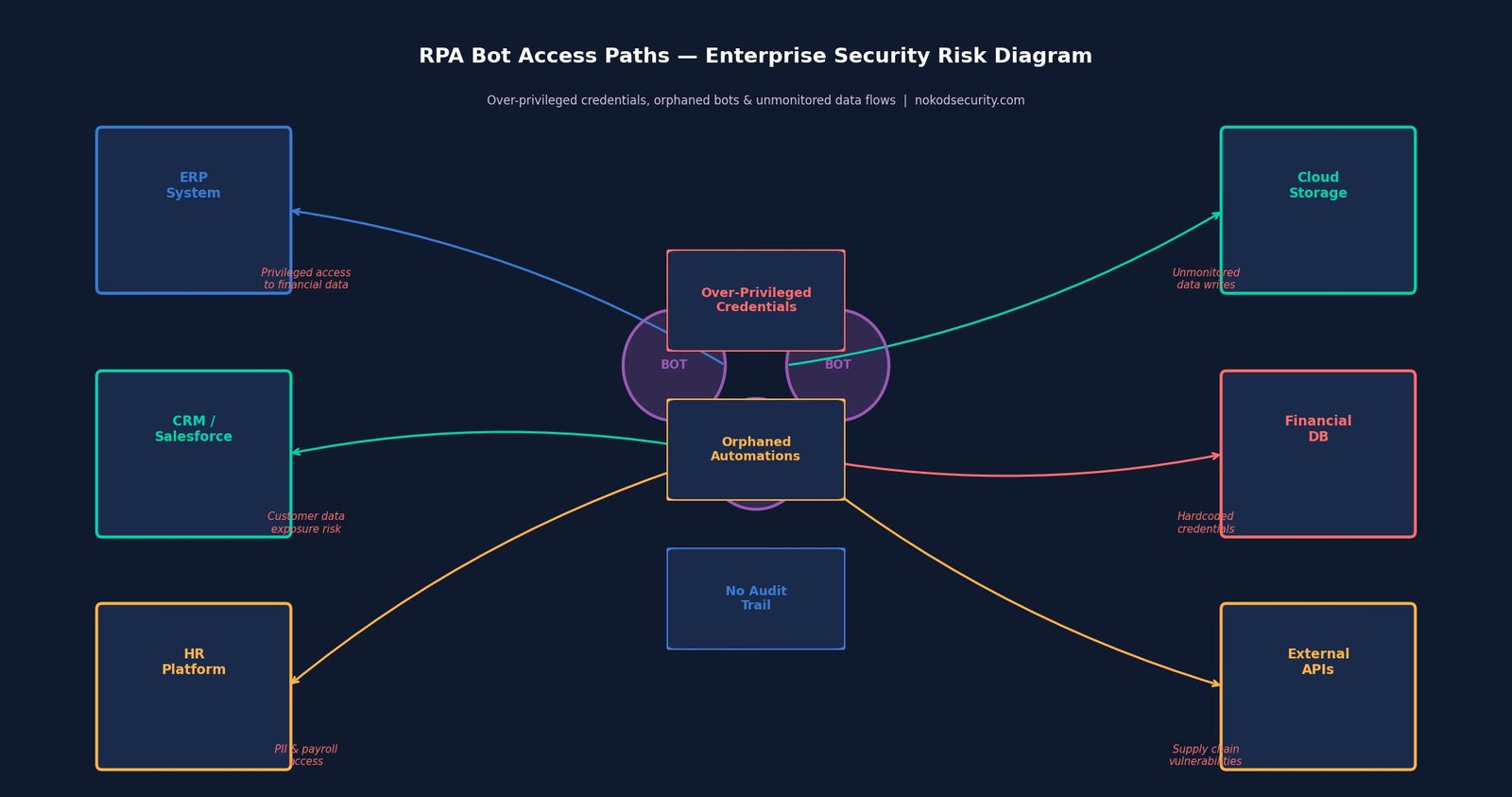
- Privileged credential exposure: RPA bots require credentials to access the systems they automate. These credentials are frequently stored insecurely – embedded in bot scripts, stored in configuration files, or shared across multiple bots – creating a persistent exposure risk that is difficult to audit and remediate.
- Principle of least privilege violations: Bots are often granted broad access to make the automation easier to build. The result is bots running with far more privilege than their function requires – a violation of basic security hygiene that creates significant blast radius if a bot is compromised or misbehaves.
- Orphaned automations: When the employee who built or managed a bot moves on, the bot typically continues running. Orphaned bots – operating under accounts or credentials that no one is actively managing – represent a persistent, unmonitored risk.
- Injection vulnerabilities: Bots that process unstructured inputs – such as email content, document text, or form submissions – can be vulnerable to injection attacks that cause them to behave in unintended ways.
- Audit trail gaps: Traditional security monitoring is designed to track human user activity. Automated bot activity may not be captured in the same audit logs, creating blind spots in incident investigation and compliance reporting.
- Supply chain risks: Bots that integrate with external systems, APIs, or third-party services introduce supply chain dependencies that may carry their own security vulnerabilities.
The Citizen Developer Dimension
The security challenges of RPA are significantly amplified by the shift toward citizen development – the phenomenon of non-technical business users building automations and bots themselves, outside the formal software development process.
Citizen developers are not security professionals. They are operations managers, finance analysts, HR coordinators, and customer service leads who have learned to use RPA tools to solve their own workflow problems. They are motivated by efficiency, not security. They make decisions about credential storage, access permissions, and data handling based on what makes the automation work, not what makes it secure.
The result is a long tail of citizen-built automations that collectively represent a significant and largely unmanaged attack surface. A single large enterprise may have hundreds or thousands of these automations running across its environment, most of them unknown to the security team, many of them carrying credentials with more access than they need, and some of them no longer actively maintained by anyone.
Research on enterprise citizen development and its governance implications is well-documented. The IEEE Computer Society has published extensively on the governance challenges that arise when software development is democratized beyond professional developers.
How the Market Is Addressing RPA Security
The RPA security market is still maturing. Platform vendors have introduced native security features – UiPath, for example, offers credential management through its Orchestrator platform, and Automation Anywhere has built governance controls into its Cloud platform. These native features are valuable but have meaningful limitations: they are platform-specific, they require significant configuration to be effective, and they do not address the growing volume of RPA capabilities embedded in broader no-code platforms like Power Automate.
The broader security industry has begun to develop dedicated solutions for the automation security problem. Privileged Access Management (PAM) vendors have added bot identity capabilities. SIEM platforms have created analytics rules for detecting anomalous bot behavior. Identity governance tools have extended their coverage to service accounts used by RPA systems.
But none of these approaches addresses the fundamental challenge of governing citizen-built automations across heterogeneous platforms with a unified view, continuous monitoring, and actionable remediation guidance.
Nokod Security: Enterprise-Grade Governance for Automation Security
Nokod Security’s approach to automation security is built on the recognition that the RPA problem cannot be solved platform by platform or control by control. What enterprises need is comprehensive visibility across all their automation assets – regardless of which platform they were built on – combined with continuous security analysis and practical remediation pathways.
Nokod supports UiPath as part of its multi-platform coverage, automatically discovering and mapping automations, analyzing them for security risks, and surfacing findings with the context security teams need to understand and prioritize what they are looking at. The platform identifies the specific risk patterns that characterize enterprise RPA environments: over-privileged credentials, injection vulnerabilities, orphaned automations, insecure data handling, and unsanctioned external integrations.
A critical aspect of Nokod’s approach is its recognition that the security team is not the only actor who needs to take action. Many of the remediations for common RPA security findings need to be carried out by the citizen developers or business owners who built the automations. Nokod is designed to enable this: security findings are surfaced with clear, actionable guidance that business users can understand and act on, and where possible, one-click remediation options eliminate the need for developer expertise.
Building a Citizen Developer Governance Framework
Organizations that want to address the security risks of citizen development at scale need more than tooling alone – they need a governance framework that defines how citizen developers are expected to operate, what guardrails are in place, and how security oversight is maintained without killing the agility that makes citizen development valuable.
Key components of an effective citizen developer governance framework include:
- Inventory and discovery: You cannot govern what you cannot see. Continuous, automated discovery of all citizen-built assets is the foundation of any governance program.
- Risk classification: Not all citizen-built automations carry equal risk. A framework for rapidly classifying automations by risk level – based on data sensitivity, external exposure, and privilege level – enables proportionate oversight.
- Security standards: Clear, practical security standards for citizen developers – covering credential management, data handling, testing, and documentation – must be communicated in terms that non-technical builders can understand and follow.
- Ownership and lifecycle management: Every automation should have a designated owner, and governance processes should trigger reviews when owners change roles or leave the organization.
- Continuous monitoring: Governance cannot be a one-time audit. Continuous monitoring for new assets, configuration changes, and behavioral anomalies is essential.
Conclusion
The automation revolution driven by RPA and citizen development has delivered real value – and it is not going away. Enterprises will continue to expand their automation footprint, and the volume of citizen-built automations will continue to grow. The question is not whether to embrace this trend, but how to do so without accepting a security risk that is invisible, unmanaged, and growing.
Effective citizen developer governance requires acknowledging that the people building these automations are not security experts – and building programs and platforms that meet them where they are. Nokod Security’s approach, which combines deep AppSec expertise with practical tooling designed for both security professionals and business users, represents a model for how enterprises can have both the speed of citizen development and the security governance that responsible enterprise operations require.

Edge AI Explained: How On-Device AI Processing Is Replacing the Cloud
The Rise of System-in-Package (SiP): How Advanced IC Packaging Is Redefining Electronics Miniaturization
Wire Bonding vs. Flip Chip: Navigating the Evolving World of IC Interconnect Technology

-
Business Solutions2 years ago
Understanding A2P Messaging and the Bulk SMS Business Landscape
-

 Business Solutions2 years ago
The Power of Smarts SMS and Single Platform Chat Messaging
-

 Business Solutions2 years ago
Exploring OTP Smart Features in Smart Messaging Services
-

 Business Solutions2 years ago
Live Video Broadcasting with Bonded Transmission Technology
-

 Business Solutions1 year ago
The Future of Healthcare SMS and RCS Messaging
-

 Business Solutions2 years ago
2-Way Texting Solutions from Company Message Services
-

 Business Solutions2 years ago
Communication with Analog to Fiber Converters & RF Link Budgets
-

 Business Solutions2 years ago
B2B vs. B2C Content Creation: Tailoring Your Message to Win the Deal