


Marketing & Analytics
A Complete Guide To HubSpot’s New B2B Marketing, Sales Hub, and Prospecting Tool
For businesses looking to get ahead in their B2B marketing efforts, HubSpot offers a unique tool that allows them to combine their customer relationship management (CRM) strategies with advanced marketing automation. With HubSpot CRM integration, businesses can easily draw on the advantages of having both a centralized system for managing prospects and customers as well as an automated process for creating and disseminating campaigns. In this blog post, we’ll walk through how you can leverage your existing CRM setup with HubSpot’s B2B Marketing Solutions to generate higher ROI from your activities.

HubSpot, a leading CRM, sales, and marketing platform, recently announced an update to its software that includes a new B2B marketing, sales hub, and prospecting tool. This update is designed to help businesses better connect with their customers and prospects by providing more features and integrations. We will look at the new features of HubSpot’s B2B marketing, sales hub, and prospecting tool. We will also provide a step-by-step guide to connecting with your customers and prospects using these new features.
What is HubSpot’s new B2B marketing, sales hub, and prospecting tool?
HubSpot’s new B2B marketing, sales hub, and prospecting tool is a complete solution for businesses looking to improve their online presence and reach new customers. The platform provides everything you need to create a successful online marketing campaign, including a website builder, CRM, email marketing, and SEO tools. The new sales hub and prospecting tool make finding and connecting with potential customers easy.
How HubSpot Sales works
HubSpot Sales is a tool that helps sales reps and teams manage their pipeline and close more deals. It allows users to see which deals are in progress, creates new deals, and tracks their performance against their goals. It also has features like email tracking and integration with other HubSpot tools.
HubSpot’s new B2B marketing tool
HubSpot’s new B2B marketing tool is designed to help businesses attract more prospects, convert leads, and close more deals. The tool includes a drag-and-drop email builder, a HubSpot CRM integration, and a lead capture form. It also offers several features unique to HubSpot, including the ability to automatically add new contacts to your CRM, send personalized emails to your leads, and track your prospects’ engagement with your content.

Using HubSpot’s new B2B marketing tool
If you’re a HubSpot customer, you now have access to the beta version of their new B2B marketing tool. This tool is designed to help you better connect with prospects and customers and manage your sales and marketing efforts in one place. Let’s show you how to use the new B2B marketing tool.
First, log in to your HubSpot account and click on the “B2B Marketing” tab at the top of the page.
On the left-hand sidebar, you’ll see a list of features included in the tool. We recommend looking at the “Contacts” and “Companies” sections to get started.
In the “Contacts” section, you can view all your contacts’ information in one place. You can also add tags to contacts to segment them into different groups. For example, you could tag all your current customers with the “customer” tag.
The “Companies” section lets you view information about companies associated with your contacts. This is useful for keeping track of which companies are interested in your products or services.
To start using the new B2B marketing tool, simply click on the feature that you want to use from the left-hand sidebar. If you have queries about using the tool, HubSpot has created a helpful support page with tutorials and FAQs.
The benefits of using this B2B prospecting tool
The HubSpot Sales Hub is a powerful new tool that enables B2B marketers to quickly and easily find and connect with their ideal customers. The Sales Hub provides users with a complete view of their sales pipeline, including seeing which leads have the best chance to convert into customers. In addition, the Sales Hub offers users several powerful features that make it easy to connect with prospects, including:
-A personalized dashboard that gives users quick access to the information they need to make decisions about their sales pipeline
-Detailed contact information for each lead, including contact history, notes, and tasks
-The ability to create custom lists of leads based on criteria such as job title, location, or company size
-Integrated CRM and email tools that make it easy to stay organized and connected with prospects
-Real-time notifications that keep users up-to-date on the status of their sales pipeline
Getting started with using this B2B prospecting tool
If you’re a HubSpot customer, you now have access to their new B2B marketing, sales hub, and prospecting tool. Here’s how to get started using it:
- The first step is to build a list of your target prospects. You can manually enter their information into the system or import a list from a CSV file.
- Once you have your list of prospects, you can start building your campaigns. Each campaign can include multiple email templates, lists of targeted companies, and lists of contacts within those companies.
- As you build out your campaigns, you can add additional content such as blog posts, white papers, eBooks, and more. This content will be used to attract and engage your prospects.
- Once you’ve built out your campaigns, it’s time to start executing them. You can do this manually or automate the process using HubSpot’s workflow tool.
- Finally, you’ll want to track your results to see how well your campaigns are performing. HubSpot’s reporting tools will help you track things like leads generated, conversion rates, and more.
Tips for using this HubSpot B2B tool effectively
There are some factors to remember when using this new HubSpot B2B tool:
- First and foremost, this tool is designed to help you streamline your marketing, sales, and prospecting efforts. Having realistic expectations for what it can and cannot do is essential.
- Secondly, take full advantage of the automation features. This will save you time and will allow you to focus on other business areas.
- Finally, don’t be afraid to experiment with the available features and options. The more you use this tool, the more familiar you’ll become with its potential and how to best utilize it for your needs.
Case studies of businesses using HubSpot B2B marketing and sales
Many businesses are doing amazing things with HubSpot’s new B2B marketing, sales, and prospecting tools. This section will examine some case studies of companies using these tools to power their growth.
One business that’s doing great things with HubSpot is Xcelerate Media. They’re a content marketing agency, and they’ve used HubSpot to increase their website traffic by 400%.
Another business, Acme Corp, used HubSpot’s sales tools to increase their close rate by 20%.
And finally, we have Blumebox, who used HubSpot’s marketing automation to increase their leads by 300%.
These are just some examples of the countless businesses that are seeing success with HubSpot’s new tools. If you’re searching for more inspiration, check out the case studies on HubSpot’s website.
Final FAQs
HubSpot’s new B2B marketing, sales hub, and prospecting tool is a powerful way to connect with your customers and prospects. Here are a few frequently asked questions or FAQs about how to use this tool.
Q: What is the best way to use HubSpot’s new B2B marketing, sales hub, and prospecting tool?
A: The best way to use HubSpot’s new B2B marketing, sales hub, and prospecting tool is to connect with your customers and prospects through the tool’s powerful features. This tool allows you to easily create and track your marketing campaigns, manage your sales pipeline, and stay connected with your prospects through the built-in CRM.
Q: How do I start with HubSpot’s new B2B marketing, sales hub, and prospecting tool?
A: Getting started with HubSpot’s new B2B marketing, sales hub, and prospecting tool is easy. Simply sign up for a free trial at https://www.hubspot.com/products/marketing/sales-hub/prospecting-tool. Once you’ve registered for a free trial, you’ll have full access to all of the tool’s features.
Q: What features are available in HubSpot’s new B2B marketing, sales hub, and prospecting tool?
A: Some of the key features available in HubSpot’s new B2B marketing include creating and tracking marketing campaigns, managing your sales pipeline, and staying connected.HubSpot’s new B2B marketing tools are a game changer for sales and marketing teams. The new Sales Hub makes it easy to manage your sales pipeline and connect with prospects, while the B2B prospecting tool allows you to quickly find and connect with potential customers. With these two powerful tools at your disposal, you’ll be able to take your marketing and sales efforts to the next level.


Edge AI Explained: How On-Device AI Processing Is Replacing the Cloud
The phrase ‘AI in the cloud’ dominated the technology conversation for most of the past decade. But for a growing number of applications – autonomous vehicles, industrial inspection, smart cameras, medical devices – cloud latency and connectivity dependence are not acceptable constraints. The answer is edge AI: the practice of running AI inference directly on the device generating the data.
This shift is not incremental. It represents a fundamental rethinking of where intelligence lives in a computing system. Understanding the architecture, tradeoffs, and hardware that enables edge AI is essential for any engineer or product team building AI-powered systems today.
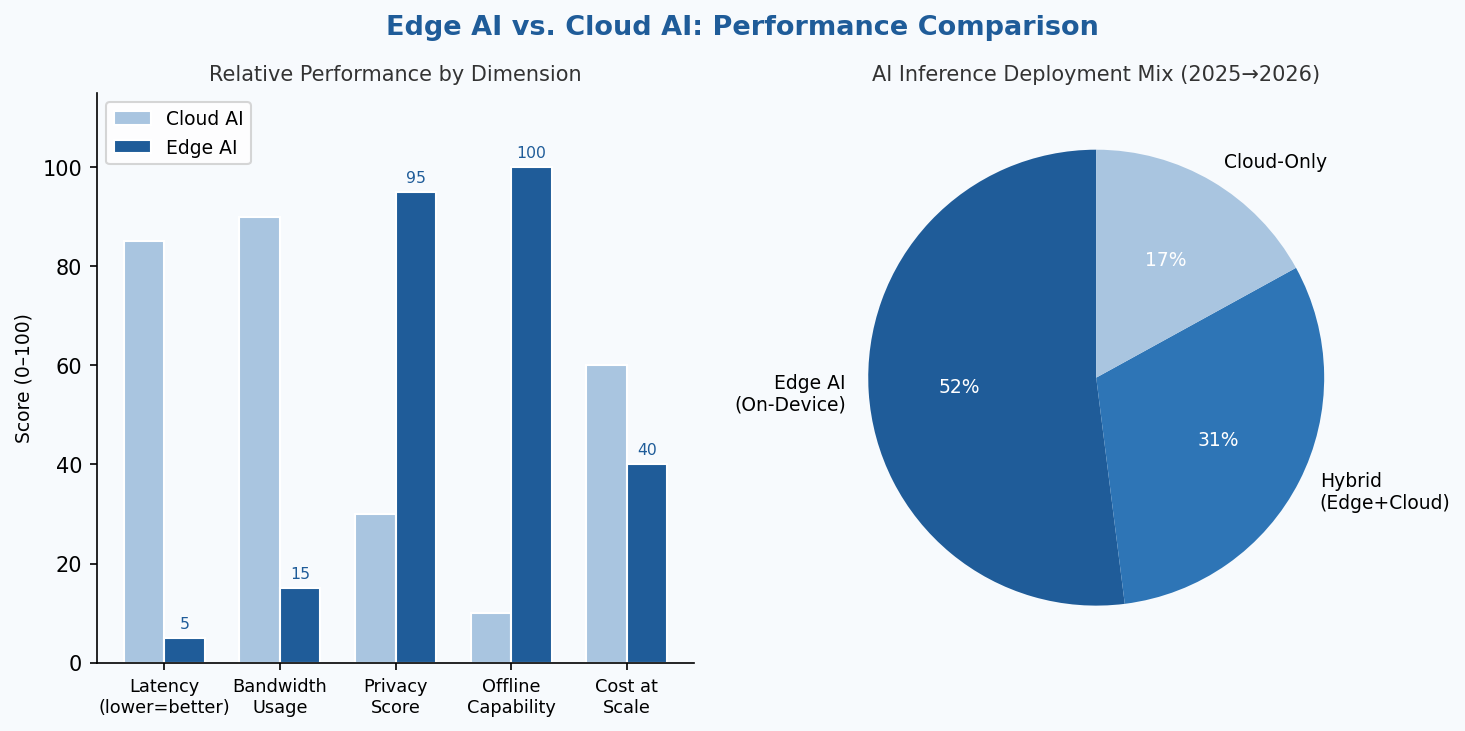
Figure 1: Edge AI vs. Cloud AI – relative performance across latency, privacy, cost, and offline capability, plus 2025–2026 deployment mix shift.
What Is Edge AI?
Edge AI refers to AI inference performed locally – on a device at or near the data source – rather than on a remote server or cloud platform. The ‘edge’ is defined by proximity to the data: a camera, a robot, a vehicle, a medical monitor.
The core operation in edge AI is inference: feeding data through a trained neural network to produce a prediction, classification, or detection result. Training these models still typically happens in the cloud using large GPU clusters. But once trained, the model can be compiled and optimized to run on purpose-built edge hardware.
Why ‘AI at the Edge’ Is Gaining Momentum
Three converging forces are driving the move from cloud to edge:
- Latency requirements: Applications like autonomous driving, industrial safety systems, and augmented reality require decisions in milliseconds. Round-trip latency to a cloud data center cannot reliably achieve this.
- Connectivity constraints: Many edge environments – factories, agricultural fields, underground infrastructure – have unreliable or absent internet connectivity. Cloud-dependent AI is not viable here.
- Data privacy and sovereignty: Regulations in healthcare, finance, and government increasingly restrict where data can be processed. On-device inference ensures that sensitive data never leaves the physical device.
The economics have also shifted. The cost of purpose-built edge AI silicon has dropped significantly, while cloud inference costs scale with usage. For high-frequency inference tasks – such as analyzing every frame from a hundred cameras – the break-even point strongly favors edge processing.
The Hardware That Makes Edge AI Possible
Not all processors are suited to AI inference. Running a modern object detection network on a general-purpose CPU is feasible but inefficient. Dedicated AI accelerators solve this through hardware architecture designed for the matrix multiplication and convolution operations that dominate neural network computation.
| Hardware Type | Architecture | Typical Use Case | TOPS Range |
| General CPU | Sequential / SIMD | Low-throughput inference | < 1 TOPS |
| GPU (embedded) | Parallel CUDA cores | Flexible, power-intensive | 1–10 TOPS |
| Dedicated AI Accelerator | Dataflow / systolic arrays | High-efficiency inference | 10–50+ TOPS |
| Vision Processing Unit | Fused vision + AI pipeline | Camera-integrated applications | 5–30 TOPS |
Purpose-built AI accelerators such as the Hailo-8 AI Accelerator deliver significantly higher TOPS-per-watt than GPU-based alternatives – a critical metric for battery-powered or thermally constrained edge deployments.
Edge AI vs. Cloud AI: A Practical Comparison
| Dimension | Cloud AI | Edge AI |
| Latency | 50ms–2000ms (network dependent) | < 10ms |
| Privacy | Data transmitted externally | Data stays on-device |
| Offline | Not available | Full functionality |
| Model complexity | Unlimited (server resources) | Constrained by hardware |
| Cost model | Pay-per-inference, scales up | Fixed hardware investment |
| Best for | Batch processing, complex models | Real-time, latency-critical |
Software: The Missing Piece in Edge AI Deployments
Hardware capability is only as useful as the software ecosystem surrounding it. Deploying a neural network to an edge device requires a compilation toolchain that translates the model – typically developed in PyTorch or TensorFlow – into an optimized binary for the target hardware.
The best edge AI platforms provide:
- A model compiler that handles quantization, layer fusion, and memory optimization automatically
- A runtime library for efficient inference execution
- Pre-compiled model libraries (model zoos) for common tasks
- Profiling tools to measure per-layer performance and identify bottlenecks
- Integration examples for popular platforms including Raspberry Pi, NVIDIA Jetson, and industrial SBCs
The Hailo AI Software Suite delivers this complete pipeline, making it possible to go from a PyTorch model to a running edge deployment with minimal platform-specific engineering. The Hailo Developer Zone provides documentation, tutorials, and pre-compiled models to accelerate time-to-deployment.
For a broader technical overview of edge AI architectures, IEEE Spectrum’s coverage of edge computing provides a solid reference point on where the industry is heading.
Real-World Edge AI Use Cases
The breadth of edge AI applications continues to expand. Current high-volume deployments include:
- Smart retail: People counting, queue detection, and product recognition running on in-store cameras without cloud dependency.
- Automotive ADAS: Driver assistance features – lane departure, pedestrian detection, sign recognition – all processed in-vehicle for safety-critical response times.
- Industrial quality control: Automated optical inspection on production lines, detecting defects at rates that exceed human inspection.
- Smart home and security: Object recognition, package detection, and intruder alerts running locally on home hubs or camera modules.
- Healthcare monitoring: Patient movement analysis and fall detection in care environments, with strict data privacy guarantees.
Conclusion
Edge AI is not a replacement for cloud computing – it is a complement that brings intelligence to where data is generated. For applications requiring real-time response, offline capability, or data privacy, it is now the architecturally correct choice.
For deeper technical coverage of how edge AI is reshaping industries, visit aitechpublication.medium.com for analysis from practitioners building these systems today.
Business Solutions
Plum vs. Roma Tomato Varieties: What Growers Should Know
Learn the differences between Plum and Roma tomatoes, including growing tips, uses, disease resistance, and yield.


Tomatoes are one of the most widely grown vegetables (botanically a fruit) in the world, beloved by home gardeners and commercial growers alike for their versatility, flavor, and productivity. Among the many cultivars available, two of the most popular classes for sauce, paste, canning, and processing are the plum‑type tomatoes and the widely known Roma‑type tomatoes. This comprehensive comparison explores the characteristics, growing requirements, disease resistance, uses, and economic considerations that every grower, from backyard hobbyist to commercial farmer, should understand before choosing between these two tomato groups.
In particular, growers looking for robust paste tomatoes often explore plum tomato varieties first because of their thick walls, low moisture content, and suitability for sauces and pastes. At the same time, roma tomato varieties continue to win favor for many of the same reasons, especially in regions where climate and soil conditions favor determinate growth. Understanding the nuanced differences and similarities between plum and Roma types can help growers optimize their production and ensure the best results for their intended use.
Tomato Classification: Understanding the Basics
Before diving into specifics, it’s important to clarify the broader classification of tomatoes:
- Determinate vs. Indeterminate:
- Determinate tomatoes stop growing when fruit sets on the top bud, leading to concentrated harvests — often preferred for processing.
- Indeterminate tomatoes continue to grow and produce fruit until frost, providing extended harvests — typical for fresh market tomatoes.
- Plum and Roma types can fall into either category, but many classic processing types are determinate.
- Fruit Shape and Usage:
- Tomatoes vary widely in shape, size, and internal structure. Plum and Roma tomatoes are both paste tomatoes thicker flesh, fewer seeds, and less juice compared to slicing tomatoes making them ideal for sauces, pastes, and canning.
Origins and History of Plum and Roma Tomatoes
Plum Tomatoes
Plum tomatoes have been cultivated for centuries, particularly in Mediterranean regions such as Italy and Spain. Their elongated shape and dense interior made them ideal for sun‑drying and sauce preparation long before refrigeration and commercial processing became widespread.
The term “plum tomato” refers broadly to a class of paste types with thicker flesh and fewer seeds than slicers. This class includes classic heirloom varieties as well as modern hybrids developed for yield, disease resistance, and consistency.
Roma Tomatoes
“Roma” is a specific type within the broader plum class. While all Romas are plum types, not all plum types are considered Roma. Romas were popularized in the mid‑20th century as a reliable processing tomato, particularly in North America. They were bred for uniformity, disease resistance, and determinate growth, which simplifies mechanical harvesting.
The National Center for Home Food Preservation notes their strong performance in canning and sauces due to solid flesh and concentrated flavor.
Fruit Characteristics Compared
Shape and Size
- Plum Tomatoes:
- Often oval or slightly tapered.
- Can vary significantly in size depending on variety.
- Heirlooms may be larger and more varied in shape.
- Roma Tomatoes:
- Typically oblong and uniform.
- Medium size (around 2–4 oz each).
- Consistent shape makes mechanical handling easier.
Flesh and Juice
- Plum Varieties:
- Generally thick‑walled with less juice.
- Ideal for paste and concentrated products.
- Some heirloom plums have more seeds and liquor than modern processing cultivars.
- Roma Varieties:
- Very dense flesh with very low moisture.
- Excellent solids content important for sauces.
- Few seeds reduce the need for seed removal during processing.
Flavor Profiles
- Plum Types:
- Can vary, especially between heirlooms and hybrids.
- Often sweeter and more complex, making them good for fresh sauce.
- Roma Types:
- Flavor is strong and robust but can be more uniform.
- Often sweeter than slicer types but not as nuanced as heirlooms.
This comparison of internal fruit characteristics mirrors what leading agricultural research institutions note: paste types are bred for solids more than flavor nuance compared to fresh market.
Growth Habits and Agronomy
Plant Size and Structure
- Plum Growers:
- Can be indeterminate or determinate.
- Indeterminate plum types continue to vine and can require trellising.
- Determinate types stop growth after flowering favorable for synchronized harvest.
- Roma Growers:
- Traditionally determinate.
- Compact growth reduces space and staking needs.
- Predictable harvest window simplifies labor planning.
Climate and Soil Requirements
Both plum and Roma tomato varieties thrive under similar agronomic conditions:
- Warm Temperatures:
- Tomatoes are warm‑season crops. Optimal daytime temps: 70–85°F (21–29°C), night temps: 55–70°F (13–21°C). Frost damage can kill vines USDA advises transplanting after last frost for most regions.
- Soil:
- Well‑drained loamy soil with pH of 6.0–6.8 preferred.
- Organic matter improves water retention and nutrient availability.
- Sun Exposure:
- Full sun (at least 6–8 hours daily) significantly increases yields.
While both types share basic requirements, Roma types often outperform in hotter climates due to breeding focus on processing reliability.
Disease and Pest Resistance
Buying disease‑resistant varieties can make the difference between a bumper crop and a failed one, especially in humid or moist climates where tomato diseases thrive.
Common Tomato Diseases
- Early Blight
- Late Blight
- Fusarium Wilt
- Verticillium Wilt
- Tomato Mosaic Virus
- Septoria Leaf Spot
Plum Tomato Resistance
Because plum types include both heirlooms and hybrids, resistance varies:
- Heirloom plum types: often lack modern resistance traits.
- Hybrid plum types: can be bred for tolerance to specific diseases.
Roma Tomato Resistance
Many modern Roma tomato varieties are bred with multiple resistance traits, often labeled with V (Verticillium), F (Fusarium), N (Nematode), and Tm (Tomato mosaic virus) designations.
Integrated Pest Management
Growers should consider strategies such as crop rotation, careful irrigation management to reduce leaf wetness, and the use of disease forecasting services from local extension offices.
Best Uses in the Kitchen
Understanding how growers plan to use their harvest should be a key factor in choosing between plum and Roma tomato varieties.
Sauces and Pastes
Both classes are excellent for sauce and paste:
- Plum types: great if a slightly more flavorful or thick texture is desired.
- Roma types: ideal for high solids and uniform cooking.
The USDA’s Agricultural Research Service highlights that paste tomatoes need a high percentage of soluble solids for efficient processing.
Fresh Eating
While neither is a traditional slicer tomato, some people enjoy plum types fresh due to higher flavor complexity. Roma types can also be eaten fresh, but are often preferred cooked.
Canning and Preservation
Low moisture means fewer adjustments in home canning:
- Both plum and Romas reduce overall processing time.
- Fewer seeds reduce bitterness in sauce.
Yield and Harvest Considerations
Harvest Timing
- Determinate types (many Romas) ripen in a narrower window — efficient for single large harvests.
- Indeterminate plum types can produce over a longer window — beneficial for ongoing harvest but requires more labor.
Total Yield
- Roma types tend to be reliable yielders in processing operations.
- Plum types vary widely by cultivar — hybrids often have high yields, heirlooms may be lower but prized for flavor.
Studies indicate that processing types bred for disease resistance and uniform maturity often outperform heirlooms under commercial conditions.
Economic Considerations for Growers
Growers need to consider not just agricultural performance but also market demand and revenue potential.
Market Demand and Price
- Processing Tomatoes: There is a strong commercial market for paste and sauce tomatoes. Large companies often contract with growers for Roma types due to uniform quality.
- Specialty Market: Plum heirlooms can fetch premium prices at farmers’ markets and specialty stores due to unique flavor.
Labor Costs
- Determinate Roma varieties require less staking and pruning, reducing labor.
- Indeterminate plums often need more labor for trellising and harvest.
Storage and Post‑Harvest Handling
- Dense‑fleshed tomatoes store better than juicier slicers.
- Roma’s uniform shape simplifies packing and mechanical processing.
For commercial economics, Cornell’s vegetable production cost estimates provide detailed insights.
Popular Cultivars Examples for Each Type
Plum Tomato Varieties (Examples)
Because this is a broader class, plum types include both heirlooms and hybrids:
- San Marzano (heirloom classic for sauce)
- Opalka (larger paste tomato)
- Amish Paste
- Big Mama
Roma Tomato Varieties (Examples)
- Standard Roma type (often VFN disease resistance)
- Roma VF (V = Verticillium, F = Fusarium resistance)
- San Marzano Improved Roma (hybrid selections with improved traits)
Seed companies and extension programs list many more recommended cultivars based on region and disease pressure.
Conclusion
Both plum and Roma tomato varieties offer excellent choices for growers interested in sauces, pastes, and processing. The key differences lie in uniformity, growth habit, and traditional naming conventions.
Understanding your specific growing environment, market demands, and production limitations can help you select the right type whether it’s a heritage plum cultivar with rich flavor, or a high‑yield Roma variety bred for resilience and uniformity.
With the proper selection and management practices, both types can deliver high yields, flavorful fruit, and satisfying results for home gardens and commercial operations alike.
In the world of startup financing, where ideas become companies and companies become global catalysts for innovation, the first meeting between founders and investors is pivotal. How a pitch is structured, what the audience expects, and even the cultural context can dramatically influence whether a startup receives funding or is dismissed. Among global entrepreneurial hubs, the venture capital environment in Israel stands out for its distinctive style and expectations. In this article, we explore how VC Israel standards compare to broader global expectations, particularly in how founders prepare, deliver, and succeed with venture capital presentations.
To understand the nuances between pitching in Israel versus other markets like the United States, Europe, or Asia, we must first examine the defining characteristics of these ecosystems. What do investors prioritize? Which metrics carry the most weight? How much emphasis is placed on storytelling versus technical depth? And crucially, how should entrepreneurs adapt their pitch decks depending on their audience?
The Cultural Foundations of Pitching
Israeli Pitch Culture: Direct, Data-Driven, and Fast
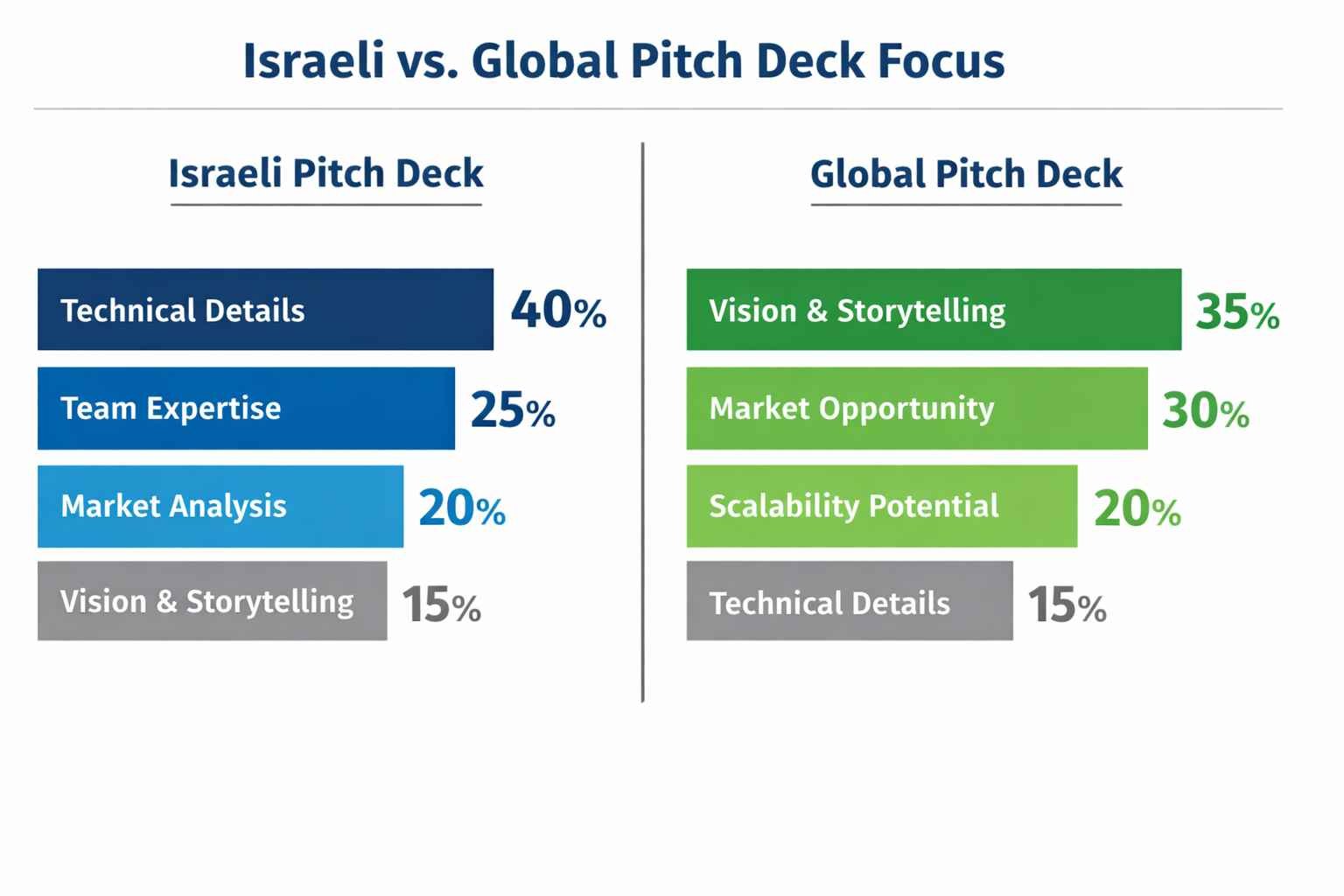
The Israeli startup scene, often referred to as “Startup Nation,” is renowned for its rapid pace, technical talent, and no-nonsense approach to business. Investors in Israel, including both local firms and global VCs with Israeli portfolios, are known for their direct questioning, deep technical due diligence, and skepticism toward overhyped narratives.
This comes from a broader cultural ethos. Israeli communication styles tend to be blunt and straightforward, with less tolerance for inflated language or polished but shallow pitches. Founders are expected to demonstrate deep mastery of their technology and market from the first slide.
For startups preparing their pitch decks, resources such as venture capital presentations from seasoned investors can provide useful templates and expectations common in the local market. These presentations often highlight:
- Clear articulation of the problem and solution.
- Early evidence of technical feasibility.
- Deep understanding of competitors and industry structure.
- Realistic financial projections rooted in verified assumptions.
Global Pitch Culture: Narrative, Scale, and Market Vision
In contrast, global pitch expectations, particularly in Silicon Valley, often emphasize visionary storytelling alongside numbers. Investors like those in Sequoia Capital, Andreessen Horowitz, or SoftBank frequently look beyond the current product to the potential scale and disruption a company can create.
Here are characteristics often associated with global pitch culture:
- Story-first approach: Founders build an emotional narrative about the world they want to create.
- Market opportunity emphasis: The larger the total addressable market (TAM), the better.
- Scalability and growth potential: Even early-stage companies pitch future expansion with confidence.
- Branding and Design: Slide decks are often polished with professional aesthetics.
This doesn’t mean global investors ignore data, far from it, but they balance hard numbers with compelling vision. For many early global stage investors, the pitch is a tool to gauge the founder’s big picture thinking, not just their current traction.
Structure and Content Expectations: Israel vs. Global Markets
Although pitch deck structures share many elements worldwide, the order, emphasis, and depth of certain sections differ between markets.
Common Global Pitch Deck Structure
Across many regions, especially in the U.S. and Europe, a commonly accepted pitch deck order includes:
- Problem Statement
- Solution/Product
- Market Size (TAM/SAM/SOM)
- Business Model
- Traction and Metrics
- Team
- Financial Projections
- Competitive Advantage
- Ask/Funding Needed
This order is not arbitrary. It reflects a flow from why the world needs your product to how you will make money and grow. Influential guides such as those from Harvard Business School and Y Combinator reinforce this structure
Israeli Pitch Deck Expectations
While many Israeli founders use a similar structure, investors often invert or emphasize sections differently:
- Technical Detail Early: Israeli investors frequently want to see technical feasibility early in the deck. They may request product architecture, prototypes, or validation data immediately after the problem statement.
- Revenue Model Later: While global decks place the business model near the front, Israeli pitch decks sometimes delay detailed monetization strategies in favor of showcasing technology superiority.
- Focus on Team Competence: The team section in an Israeli pitch deck often goes deeper, with founders expected to justify why they specifically are the right people to build this product, supported by technical resumes and benchmarks.
This divergence reflects the general sentiment of Israeli VCs that execution excellence, especially on the technical side, is the strongest predictor of success.
Preparation and Due Diligence: What Investors Look For
Israeli Investor Priorities
Investors in Israel often approach pitches with a “trust but verify” mindset. Rather than being convinced by optimistic forecasts, they want hard evidence.
Before a pitch, founders should be ready with:
- Technical proofs and validation tests.
- Detailed TAM breakdowns by real data (not just estimates).
- Competitor product comparisons with technical differentiation.
- Clear operational plans showing how milestones will be achieved.
Often, Israeli firms conduct intensive due diligence immediately after the first meeting, meaning founders must be prepared even before they enter the room.
Global Investor Priorities
Globally, while investors care about due diligence, they often allow for a vision-first pitch with iterative exploration afterward. Many global investors will:
- Accept early-stage pitch decks without full financials.
- Focus more on traction and team vision than completed development.
- Place greater weight on market disruption potential.
This doesn’t mean due diligence is lax, far from it, but it unfolds more systematically, often after initial term sheet discussions.
For example, global investors in biotech or AI will first seek the big picture, then dive into specifics during formal due diligence. A resource explaining how global VC diligence works can be found at Investopedia.
Communication Style: Directness, Storytelling, and Humor
Israeli Pitch Tone
Israeli founders often adopt a direct, straightforward, blunt approach without unnecessary elaboration. Presentations are typically high-content, low-fluff. Israeli investors may interrupt frequently with questions that test assumptions, a cultural preference that values real substance above polished narratives.
Humor can be used, but sparingly and with the expectation that it won’t replace hard information.
Global Pitch Tone
Many global markets, particularly in North America, value storytelling. Founders are encouraged to build an emotional arc:
- Start with a compelling problem.
- Introduce characters (i.e., target users).
- Describe transformation through innovation.
This style borrows from marketing and business storytelling frameworks such as those described in the Stanford Graduate School of Business Pitch Materials.
Supporting Materials: What to Bring
In Israel
Israeli investors expect highly technical appendices ready for immediate review. These may include:
- Architecture diagrams
- Prototype data
- Benchmarks and performance metrics
- Customer testimonials (especially for B2B)
Founders might also bring metrics dashboards or IDE activity logs anything that proves work done, not promises made.
Global Expectations
Globally, executives often prepare:
- Market research documents
- Unit economics breakdowns
- TAM/SAM/SOM visualizations
- Surveys or user feedback
- Branding assets
The goal is to support the pitch with both logic and narrative reinforcement.
Common Mistakes by Non-Local Founders
When founders from outside Israel present to local investors, they often make predictable mistakes:
Overemphasis on Vision Without Depth
Investors may perceive highly narrative pitches lacking data as vague or unprepared, especially in tech-intensive sectors.
Skipping Technical Specifications
Israeli investors expect rigorous technical clarity. Even for founders in non-technical roles, supporting technical co-founders should be present and prepared to answer deep questions.
Underestimating Competition
Global markets have many large players. Without direct comparisons showing a technical edge, Israeli investors may assume a product will be commoditized.
How Founders Should Adapt
If pitching in Israel:
- Lead with data and technology.
- Be ready to answer detailed questions at any moment.
- Present clear differentiation from competitors.
If pitching to global investors:
- Build a strong narrative about why the world needs your product.
- Emphasize market growth and potential scale.
- Balance vision with logic, not one over the other.
A useful strategy is to create two versions of your deck:
- A technical, data-heavy version for highly analytical audiences.
- A vision-driven version for audiences that value storytelling.
Both should contain the same core facts, but their presentation and emphasis must differ.
Tools and Resources for Pitch Preparation
Israeli and Global Templates
- VC Israel Deck Examples: The venture capital presentations available from investor groups provide real-world formats common in the Israeli market.
- Y Combinator Pitch Deck Advice: A widely cited global benchmark, the YC pitch deck template offers direction on essential slides for early-stage startups.
- Harvard Business School Guide to Pitching: Offers a thorough framework for preparing investment presentations.
Final Takeaways: Balancing Local Norms with Global Standards
As entrepreneurship becomes ever more global, founders must become bilingual in presentation styles:
- Know your audience: Research investor preferences by region.
- Customize your deck: One size does not fit all.
- Balance story and substance: Both matter in different proportions.
- Practice adaptability: Investors will drive the conversation where they want it.
- Leverage local resources: Formats like VC Israel and associated materials help align expectations.
Whether you’re pitching in Tel Aviv, New York, Berlin, or Singapore, understanding cultural expectations from the direct, data-driven style of Israeli investors to the narrative-rich approach of global markets can dramatically improve your odds of success.

Edge AI Explained: How On-Device AI Processing Is Replacing the Cloud
The Rise of System-in-Package (SiP): How Advanced IC Packaging Is Redefining Electronics Miniaturization
Wire Bonding vs. Flip Chip: Navigating the Evolving World of IC Interconnect Technology

-
Business Solutions2 years ago
Understanding A2P Messaging and the Bulk SMS Business Landscape
-

 Business Solutions2 years ago
The Power of Smarts SMS and Single Platform Chat Messaging
-

 Business Solutions2 years ago
Exploring OTP Smart Features in Smart Messaging Services
-

 Business Solutions2 years ago
Live Video Broadcasting with Bonded Transmission Technology
-

 Business Solutions1 year ago
The Future of Healthcare SMS and RCS Messaging
-

 Business Solutions2 years ago
2-Way Texting Solutions from Company Message Services
-

 Business Solutions2 years ago
Communication with Analog to Fiber Converters & RF Link Budgets
-
 Business Solutions2 years ago
B2B vs. B2C Content Creation: Tailoring Your Message to Win the Deal